
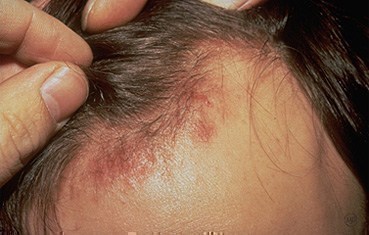
Seborrheic dermatitis, also known as seborrheic eczema, is a non-infectious, chronic inflammatory disease of the skin mostly characterized by red, inflamed skin covered with dry, flaky, or greasy scales mostly affecting the scalp. Other skin areas like the face, behind the ears, eyebrows, eyelashes, and chest may also be affected. It is a chronic condition and runs a remitting and relapsing course. In infants (babies less than one year of age), seborrheic dermatitis is known as cradle cap. Dandruff is a type of seborrheic dermatitis with flakes or scales on the scalp but minus the inflammation of the skin.
Homeopathy provides a very effective and safe treatment in cases of seborrheic dermatitis. Homeopathic remedies are of huge help in reducing flaking and inflammation on the scalp and other affected areas in seborrheic dermatitis. Accompanying factors like burning and itching sensation, and hair fall are also managed well by administering homeopathic remedies. These medicines are useful to treat both, acute and chronic seborrheic dermatitis, effectively. In chronic cases, it reduces the intensity and the frequency of a flare-up of seborrheic dermatitis to begin with. And, with time, the condition is treated and it fades away.
How Homeopathy treats Seborrheic Dermatitis?
1. Homeopathy addresses the root cause: Seborrheic dermatitis results from a fungal infection and aggravated immune system that makes a person more susceptible to it. So homeopathy treats the underlying root cause of seborrheic dermatitis. These medicines boost the self-healing mechanism of the body and strengthen immunity thus making it strong enough to fight seborrheic dermatitis on its own.
2. Safe and Gentle Treatment: Homeopathy treats seborrheic dermatitis very gently and safely with natural remedies. Homeopathic medicines are sourced from natural and highly diluted substances due to which there are no chances of side effects.
3. Long term cure rather than just Suppression: Homeopathy does not suppress the symptoms of seborrheic dermatitis. Unlike the conventional treatments that recommend the use of medicated creams and shampoos to provide temporary relief and might result in some side effects, homeopathic medicines bring about recovery from chronic cases rather than the temporary short term relief.
4. Individualized Prescription– Homeopathy follows the principle of individualization, which means treating an individual based on his/her own, peculiar symptoms. A remedy is prescribed after a detailed evaluation of an individual’s symptoms by a qualified homoeopath. The remedy that matches closely with the symptoms of the patient is chosen. Factors such as the age of the patient, chronicity of complaints and intensity of the symptoms are always considered before finalizing the potency, dose and repetition of the medicine to be administered.

Top 11 Homeopathic Medicines for Seborrheic Dermatitis
The best homeopathic medicines for the treatment of seborrheic dermatitis are Kali Sulphuricum, Natrum Muriaticum, Graphites Naturalis, Phosphorus, Thuja Occidentalis, Calcarea Carbonica, Arsenicum Album, Sulphur, Mezereum, Petroleum and Vinca Minor
1. Kali Sulphuricum – Top Remedy for Seborrheic Dermatitis
Kali Sulphuricum is the most often prescribed medicine for seborrheic dermatitis. The key symptom to administer this medicine is yellowish, sticky flakes on the scalp. The scales are greasy and moist. Itching on the scalp may occur and it worsens from heat. In some cases, there is hair loss.
When to use Kali Sulphuricum?
This medicine is most effective for cases with yellowish sticky, greasy flakes on the scalp.
How to use Kali Sulphuricum?
It works best in low potency, especially ‘X’ (biochemic) potencies. Kali Sulphuricum 6X, four tablets for adults and two tablets for children can be ingested three to four times daily.
2. Natrum Muriaticum – For White Flakes with Redness Underneath
Natrum Muriaticum is the most effective medicine for seborrheic dermatitis with white flakes on the scalp and redness on the skin beneath. Those who need it, have crusts present on the head and neck along the margins of the hair. There is marked itching on the scalp and the neck. Hair fall can be prominent with white flakes. The skin on hairy parts is greasy that is where this medicine is required.
When to use Nat Muriaticum?
It can be administered among patients with specific white flakes on the scalp along with redness of underlying skin.
How to use Nat Muriaticum?
The recommended dose of this remedy in the majority of the cases is Natrum Mur 6X to be administered three to four times daily.
3. Graphites Naturalis – To Manage Excessive Scaling and Intense Itching
Graphites Naturalis is a well-indicated medicine for those having excessive scales on the scalp along with intense itching. It is prominently administered when scales form on top of the head (vertex). There is an accompanying pain when one touches the scalp. Scales may extend behind the ears, on the margins of eyelids, and the moustache area (among the males) in some cases. The scales reduce after washing but reappear. Hair present a matted look and in some cases, hair fall is observed.
When to use Graphites Naturalis?
This remedy is highly preferred to manage cases where excessive scales are present along with severe itching on the scalp. Tenderness is marked over the affected area.
How to use Graphites Naturalis?
This medicine is usually used in low potencies like 3X, or 30C. The most commonly used potency among these is 3X potency. In mild cases, just one tablet a day of Graphites 3X is enough while in cases of high intensity, one tablet twice a day or two tablets twice a day may be required. Begin with just one tablet a day. In case no changes are noticed, consult a homeopath to increase the dose.
4. Phosphorus – For Excessive Flakiness and Hairfall
Phosphorus is highly suitable if there is excessive flakiness on the scalp along with hair fall. Sometimes dry scabs are present on the scalp. The hair falls in bunches or from some particular spots on the scalp. There is itching on the scalp that gets worse from scratching. A burning sensation on the scalp can be felt as well. In a few cases, sweating on the scalp is noticeable.
When to use Phosphorus?
Flakiness on the scalp along with hair fall in bunches is a key symptom to prescribe this medicine.
How to use Phosphorus?
Among its various available potencies, the most frequently used is 30C potency. In the beginning, Phosphorus 30C can be administered once to twice daily as per the intensity of the complaint.
5. Thuja Occidentalis – For White Flakes with Itching, Stinging On Scalp
Thuja Occidentalis is a natural remedy sourced from the plant “Arbor Vitae”. It is an important medicine that helps in cases where white flakes on the scalp form along with itching and stinging sensation. There is relief from scratching. The flakiness may extend to the ears. The hair may be dry, accompanied by hair fall.
When to use Thuja Occidentalis?
White flakes on the scalp along with stinging and itching on the scalp are the key indications to administer this medicine.
How to use Thuja Occidentalis
This medicine can be used from low 30C potency to high potency like 200 C, 1M. The potency and repetition vary from case to case. As a general rule, low potencies can be administered frequently but high potencies are taken in infrequent doses. To begin with, it is safe to start with 30C once a day only. Higher potencies should only be administered after consulting a qualified homeopath.
6. Calcarea Carbonica– For Scales on Scalp with Excessive Sweating
The use of this medicine is considered in cases where scaliness is accompanied with increased sweating over the scalp. The yellowish-white scales can be thin or thick. In some cases, the scales are dry while in others they are moist.
When to use Calcarea Carbonica?
This medicine is administered for cases presenting with yellowish-white scaliness and profuse sweating on the scalp.
How to use Calcarea Carbonica?
A patient may take it in 30C potency once a day. In case no improvement is noticed, high potencies like 200 C can be prescribed after consulting a qualified homeopath.
7. Arsenicum Album – For Dry Scales with Burning Sensation on Scalp
Another medicine on the list to treat seborrheic dermatitis is Arsenic Album. It is mostly recommended when there are dry scales on the scalp along with a burning sensation. The crusts may extend down to the forehead and ears in a few cases. The burning sensation aggravates in the evening. It can be accompanied with itching as well.
When to use Arsenicum Album?
This medicine may be administered in cases of dry scales/scabs with a burning sensation on the scalp.
How to use Arsenicum Album?
Though, it can be used in both low and high potencies, doctors usually recommend initiation of treatment with 30C power. Arsenic Album 30C can be administered once a day. Its high potencies should be taken only under the supervision of a qualified homeopath.
8. Sulphur – For Thick Crusts on Scalp with Intense Itching
Sulphur is very useful in cases presenting with crusts on the scalp. The crusts are thick, moist, and yellow. Intense itching can accompany it. The itching worsens in the evening. The scalp may be sore to touch. The hair may get dry and fall off.
When to use Sulphur?
It is the best choice of remedy for managing cases having thick, yellowish, moist crusts on the scalp that can be accompanied by severe itching in the evening.
How to use Sulphur?
This medicine can be prescribed in 30C potency once daily. Avoid using its high potencies without the doctor’s advice.
9. Mezereum- For Thick, Leathery Crusts on Scalp
Mezereum is a natural remedy sourced from the plant “Spurge Olive”. It is indicated in cases of seborrheic dermatitis, where the scalp is covered with thick leathery crusts, under which pus collects. (Crusta lactea) There are milky white scabs or scales on the scalp along with intolerable itching. Hair falls in handfuls.
When to use Mezereum?
This medicine is mainly administered when there are thick, leathery and white scales on the scalp along with unbearable itching.
How to use Mezereum?
One can take this medicine in 6C potency or 30C potency, once daily. It can be administered in 200C potency also but only after consulting a qualified homeopath.
10. Petroleum- For Seborrheic Dermatitis Worsening in Winters
Petroleum is a very well-known homeopath medicine for seborrhea / seborrheic dermatitis. It is mostly prescribed in cases where the scalp is sensitive, dry, and is covered with thick, greenish crusts. There is marked itching and burning sensation along with bleeding and redness. Deep cracks may develop on the skin folds, behind the ears and margins of the scalp. Itching aggravates in the cold weather or in the winters.
When to use Petroleum?
This medicine may be considered in cases of seborrheic dermatitis where the scalp is dry, rough and has thick scales with excessive itching that worsens at night and in the winters.
How to use Petroleum?
Petroleum can be administered in 30C potency or 200C potency. Petroleum 30C can be used once daily. High potency should only be used after consulting a qualified homeopath.
11. Vinca Minor – For Moist, Oozy Crusts on Scalp
Vinca Minor is a wonderful homeopathic remedy for seborrheic dermatitis, affecting the scalp and the face. The scalp becomes moist, oozing, and crusty. There is an irresistible desire to scratch. There is corrosive itching sensation on the scalp. A lot of sensitivity of the skin with soreness and redness from slight rubbing is present. Hair is stuck together with foul-smelling exudation. Hair starts falling and the bald spots are covered with short woolly hair.
When to use Vinca Minor?
It can be administered in cases of seborrheic dermatitis where the crusts on the scalp are oozy and there is an irresistible desire to scratch. Hair give a matted look.
How to use Vinca Minor?
The recommended dose in a majority of the cases is that of Vinca Minor 30C potency. It can be administered once a day. High potencies should only be used after consulting a qualified homeopath.
Causes of Seborrheic Dermatitis
Why seborrheic dermatitis occurs is still a question. However, certain factors are thought to play a role in its progress. They include:
1. The overgrowth and irritation by toxic substances produced by Mallasezia (a type of yeast), mainly Mallasezia Globose, found on the scalp, is said to cause seborrhoeic dermatitis. These yeasts produce lipases which hydrolyze triglycerides present in serum into free fatty acids which can penetrate the stratum corneum layer of skin and acts as an irritant inducing inflammation.
2. Genetic predisposition: A person with a family history of seborrheic dermatitis is at the risk of getting affected by it.
3. Weak immune system- Increased production of pro-inflammatory cytokines such as IL-1, IL-6 and IL-8 causes dysregulation of the T-cell mediated immunity, especially in the immuno-compromised states.
4. Oily/greasy skin — When sebaceous glands produce too much sebum which leads to clogged pores and various skin conditions and collection of sebum provides a breeding ground for the yeast that causes seborrheic dermatitis.
5. Increased level of androgen hormone and increased levels of skin lipids
Triggering or Worsening Factors for Seborrheic Dermatitis
Certain factors can trigger or worsen seborrheic dermatitis. These include:
1. Stress
2. Change of season
3. Cold dry weather
4. Sleep deprivation
5. Use of harsh soaps
6. Hormonal changes
7. History of skin complaints like Psoriasis or acne
8. Certain medicines like lithium psoralen
9. Obesity
Signs and Symptoms of Seborrheic Dermatitis
1. Inflamed, flaky skin on the scalp. It is the major sign of seborrheic dermatitis. The flakes vary from yellowish, whitish to greyish in color. In spite of the flakes, the skin on the scalp remains greasy.
Which area is affected by Seborrheic Dermatitis?
The area involved mainly is the one where skin is greasy and oily. Most commonly, it affects the scalp, beard, moustache, eyebrows, behind the ears and sides of the nose. Less commonly, in some cases it may affect armpits, groin area, buttocks, chest, around the navel, back, and area below the breasts.
2. Crust formation: In some cases, greasy skin may be covered by crusts
3. Skin redness
4. Itching and burning on the affected skin
5. Hair loss in the affected part
Who Gets Affected By Seborrheic Dermatitis?
Though, it can affect both males and females, its occurrence is more common in men than women. It can affect persons of any age group, it is common among babies less than 3 months of age, and adults between 30 to 60 years.
How to diagnose Seborrheic Dermatitis?
A doctor can easily diagnose this condition by having a careful look at the affected skin areas. Usually, no tests are needed. Very rarely, a skin biopsy (here skin cells from the affected area are scraped off and sent to a laboratory for analysis) may be needed in cases where the diagnosis is uncertain or the condition is unresponsive to treatment to find other causes behind the skin problem.
Frequently Asked Questions
1. Is dandruff and seborrheic dermatitis the same?
Dandruff is a mild form of seborrheic dermatitis limited to the scalp.
2. Is seborrheic dermatitis contagious?
No, seborrheic dermatitis is not contagious.
3. Can seborrheic dermatitis affect children?
Yes, seborrheic dermatitis can affect children too. It’s called a cradle cap.
4. Does oiling the scalp help?
Sometimes oiling the scalp aggravates seborrheic dermatitis because fungus feeds on oil.
5. What dietary changes can help in managing my seborrheic dermatitis?
There is no prescribed diet but one can see improvements by avoiding alcohol, sugary and highly processed foods.
6. Is scalp psoriasis and seborrheic dermatitis same?
No, psoriasis and seborrheic dermatitis are different but can look similar. There is also a mixed condition called sebopsoriasis.
7. What makes seborrheic dermatitis worse?
Stress, alcohol, sweating, and junk food can worsen it.
8. Can exercise worsen seborrheic dermatitis?
Yes, when exercise leads to excessive sweating, it can aggravate the symptoms of seborrheic dermatitis.
9. How can homeopathy help in seborrheic dermatitis?
Homeopathy aims to treat the root cause. It boosts immunity and thus reduces recurrence, rather than suppressing the symptoms.
10. How long will I have to take homeopathic medicines?
Immediate relief comes from a few days to a few weeks. However, to ensure that the chronic behaviour is set aside one may have to wait for months.
11. Will homeopathy help with my hair fall too?
Yes, once seborrheic dermatitis is curbed, hair fall usually reduces.
12. Is seborrheic dermatitis a fungal infection?
No, seborrheic dermatitis is not purely a fungal infection, but a yeast (Mallasezia) plays a role in setting off inflammation in susceptible areas of the skin.
13. Can conventional treatment cure seborrheic dermatitis?
Conventional treatment only controls symptoms using antifungals and steroids. Homeopathy aims to reduce the tendency by treating the root cause.
14. Are homeopathic medicines safe for long-term use?
Yes, homeopathic medicines are non-toxic, non-habit forming, and absolutely safe when prescribed well.
15. Can I continue my anti-fungal shampoos?
Yes, initially one can continue with the shampoos. As improvement sets in by using homeopathic medicines, we can taper down the use of the shampoos gradually.