
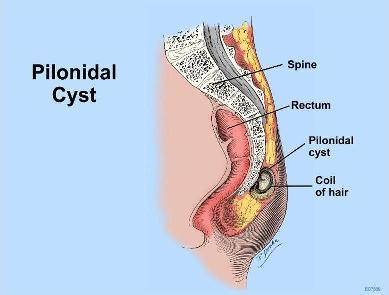

Pilonidal Cyst is the formation of a cyst at the cleft of the buttocks near the tailbone. The term Pilonidal means ‘nest of the hair’. The pilonidal cyst contains skin and hair debris. It develops when hair penetrates the skin due to friction, and the body that considers it as a foreign substance, forms a cyst around it. The cyst can get infected, get filled with pus, and form an abscess. A pilonidal sinus is formed when a tract begins from the infected cyst, and opens on the surface of the skin.
Gentle Homeopathic Care for Pilonidal Cyst
Homeopathy provides perfect treatment for cases of pilonidal cyst/sinus. These medicines help manage its symptoms like swelling, pain, itching and supports absorption of the pus discharge from the pilonidal sinus. It follows a curative approach to treat Pilonidal Cyst, rather than just provide initial relief from the symptoms. They help in dissolving the cyst. Homeopathy provides treatment for recent, long term as well as recurrent cases of pilonidal cyst. Under the conventional mode of treatment, a surgical incision of the Pilonidal Cyst is advised (which is painful, and temporary, and the cyst may recur even after surgery). However, homeopathy is a safe and efficient alternative treatment process. These cases respond exceedingly well to natural homeopathic treatment that treats it in a very safe and gentle manner and prevents the need for surgical procedures.
Individualized treatment
There are several medicines in homeopathy that helps treat cases of Pilonidal Cyst, but the prescription varies from one person to the other. The medicine selection is based on symptoms presenting signs and symptoms in every individual case. Such individualized treatment proves very effective and gives best possible results.
Homeopathy promotes self-healing
Our body has an inbuilt self-healing process that can heal health issues naturally. Homeopathic medicines boost the body’s self-healing powers to fight the infection.
Safe and natural medicines
Homeopathy uses natural medicines in treating Pilonidal Cyst cases which is its biggest strength since it has zero side effects. Homeopathic medicines do not contain any harmful chemicals. Therefore, no immediate or long term side effects are felt by using homeopathic medicines.
Top 8 Homeopathic Medicines for Pilonidal Cyst/Sinus
In the list of therapeutic medicines for treating Pilonidal Cysts, the top-rated homeopathic medicines are Silicea Terra, Myristica, Hepar Sulph, Calcarea Sulphurica, Calendula, Mercuris Solubils ,Phosphorus and Sulphur.
1. Silicea Terra – Top Remedy For Pilonidal Cyst
Silicea is the most prescribed medicine for Pilonidal Cyst. It is usually the doctor’s first choice of medicine to treat such cases. This medicine is helpful when a cyst is present in the buttock cleft, and also in the case of the pilonidal sinus with pus discharge. The pus discharge may be very smelly and fetid. The pus may be scanty or copious, thin, watery, or thick, jelly-like, and sticky. Hardness, and swelling at the cleft of the buttock are also present. Itching may also appears mostly in the daytime. Silicea helps reduce the swelling and aids the expulsion of hair and pus from the cyst.
When to use Silicea?
Silicea can be administered in cases of pilonidal cyst/sinus with passage of pus discharge whether scanty or copious that may be foul smelling.
How to use Silicea?
Its use is mostly preferred in 6X potency that can be repeated up to four times daily.
2. Myristica Sebifera – Effective in Pilonidal Sinus with pus discharge
‘Myristica Sebifera’ is of great value when it comes to curing pilonidal sinus with pus discharge. This medicine hasten the process of suppuration (pus formation) and aids in complete recovery. Myristica speeds up pus discharge from the sinus and reduces the time of complete recovery. Its use prevents surgical intervention in most of the cases of pilonidal sinus. Apart from Pilonidal Cysts, Myristica works wonders in treating suppurative diseases like abscesses, boils, carbuncles, and anal fistula.
When to use Myristica Sebifera?
This medicine is highly recommended in cases of pilonidal sinus to hasten pus discharge from sinus and shortens the recovery period.
How to use Myristica Sebifera?
The prescription of this medicine differs depending from one case to another. Low potencies like 30C can be administered two to three times a day. The use of high potency like 200C should be restricted to once daily.
3. Hepar Sulph – For Pilonidal Cyst With Pain And Pus Formation
Hepar Sulph is administered when there is pain in the cyst along with the formation of pus due to an infection. However, the pus isn’t in the stage of oozing yet. The pain is beating, throbbing, stinging, or pricking in nature. Hepar Sulph aids the drainage of pus from the cyst. Once pus begins to come out there is relief from the pain. The pus discharge is mostly blood-stained and watery. It has an offensive odour and appears like old cheese coming out from the pus. The skin above the cyst is highly inflamed, and hot. It is also very sensitive and sore to touch. In a majority of the cases, the pain aggravates at night. Exposure to cold air also aggravates the pain in some cases.
When to use Hepar Sulph?
It is mostly administered for managing throbbing, stinging, pricking, beating type of pains in the pilonidal cyst and also when there is watery blood-stained pus discharge from the pilonidal sinus.
How to use Hepar Sulph?
This medicine can be administered in 30C potency one to three times daily.
4. Calcarea Sulphurica – For Pilonidal Cyst With Yellow Pus
Calcarea Sulphurica is a very effective medicine for Pilonidal Cyst when pus discharge has started oozing from the opening. The pus is yellowish. The discharge is thick, and lumpy and may carry some bloody bits in some cases. Calcarea Sulph hastens pus discharge and aids the effective healing of the cyst.
When to use Calcarea Sulphurica?
Calcarea Sulph is a very effective medicine for managing thick, yellowish lumpy sometimes blood-stained pus discharge from pilonidal sinus.
How to use Calcarea Sulphurica?
Usually its biochemic form in 6X potency is administered in most of the cases. Calcarea Sulph 6X can be used twice or thrice daily.
5. Calendula – For Sore, Painful Pilonidal Cyst And Pus Discharge
Calendula is a natural herbal homeopathic medicine that can be prescribed when the infected area over the buttock cleft is sore, and painful along with the pus discharge. One feels pain as if the affected area has suffered a beating. The area surrounding the pus discharge point is red. There may be fever with stinging pain in the cyst. Complaints worsen at night. It is a great healing agent that heals skin infections with marked brilliance.
When to use Calendula?
One can consider its use for cases of painful, sore pilonidal cyst with pus discharge accompanied by redness around the point of the discharge of pus.
How to use Calendula?
It can be used in both low and high potencies among which the most commonly used is 30C potency once to thrice daily, depending on the intensity of the symptoms.
6. Mercurius Solubilis – For Pus Discharge with Burning, Stinging Pain
Mercurius Solubilis is administered when pus releases from the cyst, accompanied by burning and stinging pain. The pus discharge is profuse, greenish in color, and may be blood-stained and sticky. The affected area is painful and sore to touch. Itching may also be an accompanying factor. An increased amount of offensive sweat on the body is present. The symptoms get worse at night, and warmth tends to aggravate all these symptoms.
.When to use Mercurius Solubilis?
It is the best choice of medicine to treat pilonidal sinus cases with pus discharge attended by stinging and burning pains. Pus is greenish, sticky and blood stained.
How to use Mercurius Solubilis?
It provides remarkable results in 30C potency that can be administered one to two times daily.
7. Phosphorus – For Pilonidal Cyst with Bloody Discharge
Phosphorus is recommended when the discharge from the cyst is bloody. The blood is thin and profuse. Burning sensation in the surrounding skin may also surface. Phosphorus is a wonderful anti-hemorrhagic remedy. It helps in controlling the bloody discharge and also contributes towards healing the Pilonidal Sinus. It is also useful in those cases where healing has taken place in the past, and the problem has arisen again with a bloody discharge.
When to use Phosphorus?
This medicine can be administered for managing Pilonidal Cyst with bloody discharge.
How to use Phosphorus?
Phosphorus 30C can be used once or twice times daily.
8. Sulphur– for Chronic and Non-Healing Pilonidal Cyst
Sulphur is administered in pilonidal cyst or sinus when the surrounding skin appears dry, unhealthy, and prone to irritation, with a tendency for even minor injuries to suppurate. There is noticeable itching and burning sensation around the natal cleft that aggravates from warmth, scratching, sweating, or washing. The skin may show excoriation, cracks, or small pustular eruptions, especially in the skin folds, with delayed or imperfect healing. Sulphur is particularly useful in recurrent or chronic pilonidal sinuses, especially when complaints flare up in damp, warm weather or after the use of local applications that have suppressed normal healing.
When to use Sulphur?
Sulphur works well in pilonidal cyst or sinus when the condition is chronic or recurrent, with poor healing and a tendency to repeated suppuration.
How to use Sulphur?
It can be initiated in 30C potency once a day.
Signs and Symptoms of Pilonidal Cyst/Sinus
Sometimes Pilonidal Cysts do not give out any overt signs or symptoms. However, if it gets infected the following signs and symptoms may appear:
1. A dimple or swelling, and pain in the cleft of the buttocks. The size of the cyst may be small or However, the cleft of the buttocks is the major location where ‘Pilonidal Cyst’ forms. It may, rarely, form in some other areas as well like the armpit, between the fingers, cheek, navel, or genital area.
2. When this dimple gets infected a cyst is formed (a fluid-filled sac) that may turn into an abscess (pus-filled lump).
3. Itching, redness, and tenderness in the swollen
4. Discomfort while sitting also arises from this
5. Formation of sinus tract/holes in the The sinus tract is a channel that starts from the source of infection and opens on the surface of the skin. Drainage of pus or blood from the ‘Pilonidal Sinus.’ The pus may be whitish or yellowish or may have an offensive odor.
6. Hair protruding from the affected area may be
7. Tiredness, nausea and low-grade fever may also appear along with the above features in some cases.
Pilonidal Cyst and Its Causes
The exact cause of the Pilonidal Cyst is not clear. But a theory states that initially, loose hair penetrates the skin of the cleft between the buttocks. Friction (as from riding a bicycle) or rubbing makes the hair go deep into the skin. The body, considering this hair to be a foreign article, forms a cyst around it to push it out from the skin. If left untreated this cyst may lead to an abscess (pus-filled lump) or it may break open, and form a tract that emerges on the surface of the skin (which is called a Pilonidal Sinus). However, as per another theory, the trauma to the area between the buttocks is what may create this cyst.
Risk factors
Though anyone can suffer from a Pilonidal Cyst but there are certain factors that increase the risk of a Pilonidal Cyst as follows:
1. Excessive body hair (especially thick and stiff) on the
2. Inactive lifestyle, excessive sitting (as office workers, drivers) that puts pressure on the coccyx area.
3. The age group most prone to developing a Pilonidal Cyst is between 20–35
4. Pilonidal Sinus is more common among men compared to Men are three to four times more likely to get Pilonidal Cyst than women.
5. Having a family history of Pilonidal Cyst (if thick, rough body hair runs in the family).
6. Having congenital Pilonidal
7. Excessive
How to Diagnose Pilonidal cyst/sinus?
A pilonidal cyst is diagnosed mainly on the basis of history and physical examination. On inspection, midline pits, openings, or inflamed nodules may be seen, sometimes with pus, blood-stained, or foul-smelling discharge. Tenderness and local warmth suggest active infection or abscess formation. Imaging studies such as ultrasound or MRI are advised only in recurrent, chronic, or complicated cases to determine the depth and branching of sinus tracts.
Complications of Pilonidal Cyst/sinus:
1. Recurrent acute abscesses with intense inflammation and suppuration.
2. Surrounding cellulitis with local edema, erythema, and tenderness.
3. Delayed or impaired wound healing with fibrosis and scar formation.
4. Extension of infection to deeper tissues, rarely causing necrotizing infection.
5. Formation of multiple branching sinus tracts and lateral secondary openings.
6. Systemic infection (fever, sepsis) in severe untreated cases.
Frequently Asked Questions
1. Can a pilonidal cyst heal on its own?
Small, non-infected cysts may remain asymptomatic, but infected or recurrent pilonidal cysts usually do not heal permanently without proper treatment.
2. What is a pilonidal sinus?
A pilonidal sinus is a small tunnel under the skin that connects the cyst to the skin surface, often causing recurrent discharge and infection.
3. Is surgery always required for pilonidal cyst?
No. Early, mild, or uncomplicated cases may be managed conservatively. Surgery is considered for chronic, recurrent, or complicated cases.
4. Can pilonidal cyst recur after treatment?
Yes, recurrence is common, especially if preventive measures like hair removal, hygiene, and avoiding prolonged sitting are not followed.
5. Is pilonidal cyst contagious?
No. It is not contagious and cannot spread from person to person.
6. What is the difference between a pilonidal cyst and an abscess?
A pilonidal cyst is a sac under the skin, while an abscess occurs when the cyst becomes infected and filled with pus, causing increased pain and swelling.
7. Can pilonidal cyst occur again after surgery?
Yes. Recurrence can occur if hair re-enters the skin or proper post-operative care is not followed.
8. Can homeopathy prevent surgery in pilonidal cyst?
Among the cases detected early or in mild cases, homeopathic treatment may reduce infection and encourage drainage, potentially avoiding surgery.
9. Can homeopathy stop recurrence of pilonidal cyst?
Yes. Constitutional treatment in homeopathy aims to boost immunity and reduce the tendency for sinus formation, thereby minimizing recurrence.
10. Are homeopathic medicines safe for long-term use?
Yes. Homeopathic medicines are non-toxic and thus can be safely administered over extended periods to prevent recurrence.