
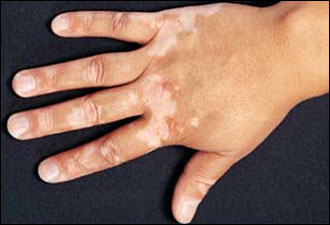
 Vitiligo, also known as leucoderma is a skin disease characterized by the development of white patches on the skin. It is caused mainly due to the improper functioning or destruction of the melanocytes cells that produce melanin pigment (which is normally responsible for providing color to hair and skin). This condition leads to psychological issues relating to appearances and at times among certain individuals (mainly adolescents and the young), this stress can take enormous proportions particularly if vitiligo develops on visible areas of the body, such as the face. Such individuals develop very strong emotions of embarrassment, feeling of being depressed, or worried about how others will react.
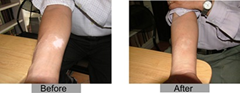
Homeopathy can treat vitiligo very effectively with safe and natural medicines. It is capable of wonderful and miraculous cures in many cases of vitiligo. Homeopathy primarily halts the further progression of the white patches on the skin and later on it promotes pigmentation in the white patches ensuring complete cure. Among the patients of vitiligo, homeopathy optimizes the immune system that helps in preventing damage to melanocyte cells. It also aims to activate the melanocyte cells to enhance the natural production of the pigment and start re-pigmentation of affected areas.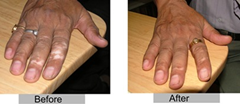
Treating vitiligo in homeopathy is a very gradual process. So one needs to remember that vitiligo is a chronic condition and can take considerable time even with the best of homoeopathic treatment, for it to be completely cured.
Homeopathic medicines are natural and safe
Homeopathic remedies are 100 per cent safe and gentle to the human body. They have no side effects and can be used safely among people of all age groups. On the other hand, conventional medicine recommends use of corticosteroids, light therapy, surgical procedures like skin grafting, and blister grafting to treat vitiligo that can have several side effects. Instead, homeopathy is a great alternative to prevent any adverse effects because of conventional medicines.
Homeopathy boosts self-healing mechanism
Each one of us has an inbuilt self-healing mechanism in our body which helps us overcome any health issues naturally. But self-healing requires some kind of a stimulus. Homeopathic medicines that are used in a highly diluted form do this job perfectly to stimulate this healing system for natural recovery in cases of vitiligo.
Homeopathy follows constitutional treatment
According to homeopathic philosophy, vitiligo is not a disease in itself but an expression of an inner disturbed state of the body. Thus, the cure should occur at a level where things have gone wrong. In order to achieve this, homeopathic medicines need to be administered as per the constitution of a person. It means the patient is analyzed on various parameters of mental, physical and familial attributes, and also a complete evaluation is carried out of the psychological environment that the patient has undergone in his life. The prescription is based at the deepest level of understanding of the patient’s disturbed inner force. I would again reiterate the fact that real cure of vitiligo takes place when the prescription is made according to the person’s constitution that treats that deep causative factor which caused this inner disturbance.
7 Best Homeopathic Medicines for Vitiligo
The top seven homeopathic medicines for the treatment of vitiligo are Calcarea Carbonica, Arsenicum Album, Sepia Officinalis, Silicea Terra, Sulphur, Arsenicum Sulphuratum Flavum and Baryta Muriatica.
1. Calcarea Carbonica – For Milky White Spots on the Skin
Calcarea Carb is a top constitutional medicine for vitiligo. It is administered to the patients who suffer from vitiligo and have milky white spots on the skin. These white spots can appear anywhere on the body. In homeopathy constitutional symptoms are given extreme importance while administering the medicine in any given case. These are unique mental and physical symptoms that guide the selection of medicine for any given case. The first most important symptom is a tendency to free perspiration over the head, chest and neck. Individuals who require this medicine are extremely intolerant to cold weather and there are peculiar cravings to eat – chalk, eggs, and pencils. They may also show a tendency to catch colds easily. Weakness of bone may also be discovered. Tendency to chronic constipation and obesity can be present. In the mental sphere, the person may show many types of fears. The prominent ones are fear of misfortune, of contagious disease, of losing reason and of insanity.
When to use Calcarea Carbonica?
The use of Calcarea Carb is recommended to treat the cases of vitiligo with milky white spots on the skin. A few constitutional symptoms that can be present include increased sweating, sensitivity to cold, cravings to eat – eggs, chalk, the tendency to catch cold easily and obesity.
How to use Calcarea Carbonica?
Both low and high potencies of this medicine work wonders. However, it is advised to begin with low potency. Calcarea Carb 30C can be administered just once a day, not more than that.
2. Arsenicum Album – For Vitiligo in Anxious Individuals
Arsenicum Album is yet another effective remedy for vitiligo for those prone to dry, and rough skin. The skin shows whitish spots and the skin is dirty. The skin complaint alternates with respiratory complaints like asthma which is a strong pointer to administer Arsenic Album. In the general sphere, warmth is a relieving factor for those who need this medicine. Warm applications on the skin and warm drinks are desirable. Burning sensation in several body parts may also be noticed. Extreme exhaustion may also be observed. There are peculiar constitutional symptoms that allow us to select Arsenic Album for treatment of vitiligo. The most prominent of these are fears and anxieties. This remedy is often indicated for those who have fears including that of death, disease, germs, and of catching infection. Patients who require Arsenic Album are very anxious personalities. They may show anxieties about health, trifles, and anxiety about others. Marked restlessness is often seen among both mental and physical planes among the persons who need Arsenic Album. The next distinctive feature for selecting Arsenic Album in vitiligo is when the individual is very careful about minor details. People demanding extreme neatness and order in everything is yet another reason why such individuals need to be administered Arsenic Album.
When to use Arsenicum Album?
Arsenic Album is a suitable medicine to treat vitiligo in those individuals who are anxious personalities and often report anxiety attacks from little things and also are very fearful. The skin in general is very dry and rough with white patches.
How to use Arsenicum Album?
The use of this medicine should be restricted to once a day in 30C potency. Consider use of high potencies only under guidance of a qualified homeopath.
3. Sepia Officinalis– For Vitiligo in People with Indifferent Attitude
Sepia is another important remedy in the list that is selected constitutionally for the treatment of vitiligo. If the overall physical and mental makeup of a person suffering from vitiligo matches with Sepia’s constitutional profile, it is then considered to possess a great ability to completely eradicate the disease. The constitutional symptoms that indicate the use of sepia are that such persons have an indifferent approach towards life and family. They show aversion towards family members and friends who were once loved with great affection. They lack interest in doing any work. A tendency to avoid both physical and mental labor is present. They are constantly depressed with marked irritability, a weeping tendency, a desire to be alone, and an aversion to consolation or sympathy. The use of Sepia must also be thought among the women with menstrual irregularities or those around menopausal age with a tendency for hot flushes. In general, soreness and itching may be present on the skin. Upon scratching, itching sensation results burning.
When to use Sepia Officinalis?
Sepia is usually helpful to persons who have vitiligo with itching and soreness on the skin. On scratching, burning occurs at the itchy places. They have indifferent behavior towards life and family like they dislike family members, lack interest in doing any type of work, and desire loneliness.
How to use Sepia Officinalis?
The recommended dose of this medicine is Sepia 30C once a day.
4. Silicea Terra – For Vitiligo with Extremely Sweaty Skin
Silicea carries a good scope to treat vitiligo when selected as per its indications.
The set of symptoms that indicate the use of Silicea are – pale and waxy skin; tendency to excessive perspiration, especially on the hands and the feet; prone to eruptions in various body parts with pus formation; the tendency to catch a cold frequently; lean, thin physical makeup. A few characteristic mental symptoms need attention while administering Silicea. The main mental symptoms are timidity and an under-confident nature. Silicea may be thought of among people who seem under-confident, fear public speaking, and are bashful and timid. Stubbornness and obstinate behavior may also indicate its use.
When to use Silicea Terra?
Use of Silicea can be considered when there are white spots on the skin along with a tendency of too much sweating mainly on the feet and the hands. Poor self–confidence, stubborn behavior and fear of speaking in public are some of the mental symptoms to be looked for when prescribing Silicea.
How to use Silicea Terra?
Among various available potencies of Silicea, the most commonly used is 6X potency. Silicea 6X can be administered one to two times daily as per the severity of the problem.
5. Sulphur – For Vitiligo with Burning and Itching Sensation on Skin
Although, Sulphur is low down in the list of medicines that treat vitiligo. Its worth is equivalent to the above-mentioned medicines. Sulphur is a deep-acting medicine used often in the treatment of various skin diseases including vitiligo. It goes deep in the body and acts at the root cause to eliminate the disease. It is a very beneficial medicine when itching and burning sensations are marked on the skin in general along with the presence of white spots on the skin. Those who require Sulphur usually show a philosophical mindset. They are popularly referred to as ‘ragged philosophers’. Their mind is constantly occupied with various theories and plans. As a result, they suffer from mental fatigue and absent-mindedness. They take little or no care for their physical appearance and even show an aversion to bathing. An extraordinary craving for sweets may also be shown as a constitutional symptom.
When to use Sulphur?
Its use is suggested mainly when a person has white spots on the skin and has a tendency to feel itching and burning sensation in different parts of the skin.
How to use Sulphur?
Sulphur is usually used in 30C potency in infrequent doses like one or two times in a week.
6. Arsenicum Sulphuratum Flavum– For Chronic, Obstinate Skin Discoloration
Ars Sulph Flavum is a highly useful medicine in chronic and stubborn cases of vitiligo/leucoderma. The white patches are rough, dry and may be associated with itching or burning sensation, especially after washing. The skin appears unhealthy and dirty looking. Symptoms generally worsen in cold weather and improve with warmth.
When to use Arsenicum Sulphuratum Flavum?
This medicine should be administered in cases of leucoderma where the patches are rough, dry and chronic.
How to use Arsenicum Sulphuratum Flavum?
It can be administered in 30C potency two to three times daily for good results.
7. Baryta Muriatica– For Vitiligo Linked to Defective Nutrition
It is administered in cases of vitiligo associated with defective nutrition and glandular involvement. It is mostly suitable for children or elderly patients who are shy, timid, and physically weak with enlarged glands and delayed mental and physical development. White patches may appear along with general underdevelopment or senile degeneration.
When to use Baryta Muriatica?
This medicine is administered to the patient who is timid, shy, and lacks confidence. White patches may appear along with glandular weakness and poor nutrition.
How to use Baryta Muriatica?
It can be used in 30C potency to begin with and the potency can be raised to 200C or 1M after consulting a qualified homoeopath.
Causes of Vitiligo
What causes Vitiligo is not very clear but doctors and researchers are beginning to believe that Vitiligo resembles an autoimmune disorder. It means that the melanin pigment (that is responsible for giving color to our skin) that produce cells of the skin are destroyed by the body’s antibodies (defense cells).
In some cases, it has been observed that the onset of Vitiligo is related to a psychologically stressful events in the patient’s life. People with a family history of Vitiligo are more prone to develop these white patches. Ninety five per cent of all those who develop Vitiligo, start developing symptoms before the 40th year of their life.
Other factors that are more common with those suffering from Vitiligo are the presence of other autoimmune disorders, a history of sunburns, rashes, and other skin disorders, and hair turning grey before the age of thirty-five.
Signs and Symptoms of Vitiligo
People who suffer from Vitiligo develop white patches on their skin of irregular sizes and shapes. Vitiligo is more common on the exposed areas for example face, hands, neck, and arms. It also occurs on covered areas too like genitals, breasts, and legs. In some patients the hair may also turn grey early and on the inside of the mouth, white discoloration may also occur. It can affect a particular localized area of skin or many areas on the skin. In some cases, itching is felt on the skin before the onset of depigmentation.
The spread of Vitiligo cannot be determined. It may stop completely after the first patch but often these patches do spread. For some patients, further development may take years and for others, the large areas can be covered in months.
Types of Vitiligo
Vitiligo is primarily classified into two major categories:
Type 1- Segmental Vitiligo
It usually affects one side of the body (asymmetrically) and the patches appear in a segment or in stripes. It often starts in childhood, progresses rapidly for a period before stabilizing.
Type 2- Non-Segmental Vitiligo
This has many variants such as:
1. Generalized Vitiligo- The patches are symmetrical across large areas of the body, begins often at the extremities (limbs) or eyes and progresses over time.
2. Focal Vitiligo- This is characterized by a single patch localized to a particular area of the body. It does not spread much.
3. Mucosal Vitiligo – It mostly involves mucosal membranes and affects lips and genitals.
4. Universal Vitiligo- It is an extremely rare form with depigmentation over 80 per cent of the skin.
Is there a Genetic Relation to Vitiligo?
Ongoing research and studies shows about 25-30 per cent of vitiligo cases are genetic. This implies that this condition is hereditary and one may inherit vitiligo if it runs in the family. Vitiligo is a polygenic and multifactorial disorder, which means that multiple genes are involved in its pathophysiology and various environmental factors affect its development. Genetic involvement is mainly related to the immune system. For example- Gene NLRP1 (responsible for immune system regulation) and Gene TYR (related to melanin production).
Since it is an autoimmune condition, it is most likely to occur in individuals who have other autoimmune conditions such as- Addison’s disease, Hashimoto’s Thyroiditis, Grave’s Disease, Type-1 Diabetes Mellitus and Rheumatoid Arthritis.
Frequently Asked Questions
1. Is vitiligo a serious disease?
No, vitiligo is not life-threatening or dangerous. It mainly affects appearance, not overall health.
2. Is vitiligo contagious?
No, vitiligo does not spread by sharing food, touch, or close contact.
3. Why do white patches develop?
They develop when pigment producing cells stop working or are destroyed.
4. Can vitiligo spread to other parts of the body?
In some people it may spread gradually, while in others it remains stable for years.
5. Is vitiligo hereditary?
Vitiligo can run in families, but not everyone with a family history develops it.
6. Does vitiligo affect only the skin?
Mostly yes, but sometimes hair over the patches may also turn white.
7. Can stress cause vitiligo?
Stress cannot simply cause vitiligo. It may trigger or aggravate vitiligo in some individuals.
8. Is there a permanent cure for vitiligo?
There is no guaranteed permanent cure. However, the treatment can help control the de-pigmentation and halt the disease from progressing.
9. Can vitiligo be treated with homeopathy?
Homeopathy aims to improve pigmentation and slow progression by treating the individual as a whole.
10. Should I avoid any foods if I suufer from vitiligo?
There is no strict diet or specific foods, but a healthy and balanced diet is best advised.
11. Can vitiligo affect children?
Yes, vitiligo can occur at any age, including childhood.
12. Is sun exposure harmful in vitiligo?
White patches are more sensitive to sunlight, so protection from sun is important.
13. Will vitiligo affect my daily life?
Vitiligo does not curb routine activities, but emotional support is helpful.
14. Can vitiligo stop on its own?
Yes, in some cases vitiligo stabilizes without further spread.
15. Can I take homoeopathic medicines with other treatments?
Yes, homoeopathy can be used alongside the conventional treatment for better results. But do consult your doctor before combining both modes of treatments.