

Top 9 Best Homeopathic Medicines for Psoriasis
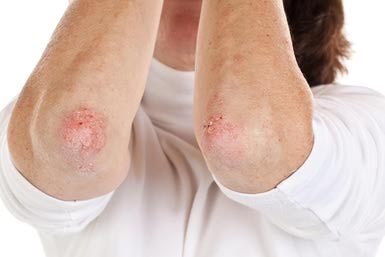
Psoriasis is known as an autoimmune skin disease characterized by well-defined red patches on the skin covered with silvery-white scales. In this disease, skin cells spread at a speed more than normal. Skin cells normally grow and are shed every 28 to 30 days. However, in psoriasis, the skin cells grow more rapidly – every 3 to 5 days. The skin is not able to shed the excessive cells as fast as they appear on the surface. This build-up of cells on the skin is referred to as plaque.
Homeopathy: A Safe, Natural, and Non-Suppressive Approach to Psoriasis
Homeopathy offers the best natural treatment for autoimmune skin conditions including psoriasis. It has certain clear advantages including the absence of any side-effects and non-suppression of psoriasis. In psoriasis, a patient is in need of a treatment that can control the indiscriminate skin cell proliferation. Homeopathy can successfully cure it by optimizing the over-active immune system, hence curing it from its point of origin.
In the traditional approach, corticosteroids are used topically and orally that might give an early result by suppressing active lesions but have side effects. Their use makes the condition more complex since after one has left these medicines, symptoms re-emerge with much worse conditions. Therefore, homeopathy can be a safe line of treatment for psoriasis as it uses non- suppressive remedies.
Gradual and Holistic Relief in Psoriasis with Homeopathy
Homeopathic remedies not only reduces the frequency and severe of the symptoms like flaking, itching, cracks and aids healing of eruptions, it also prevents further spread of eruptions. It can also manage joint pains that may occur in cases of psoriasis. To get desired results, one has to understand that homeopathy works quite gradually and one has to show patience before one is fully treated from a disease that is not just chronic and autoimmune but also obstinate in nature.
Homeopathy Optimises Rather Than Suppresses the Immune System
Psoriasis is an autoimmune skin disease in which the body’s immune system becomes overactive and inadvertently attacks healthy skin cells, leading to inflammation, redness, scaling, and thickened plaques. The objective of homeopathic treatment is to regulate and balance this heightened immune response rather than suppress it. By working at the root level, homeopathic remedy helps slow down the progression of chronic symptoms, reduce inflammation, and support the body’s natural healing process. It is important to understand that homeopathic medicines do not suppress the immune system, instead, they help restore immune balance in a mild and holistic manner.
Top 9 Homeopathic Medicines for Psoriasis
The top homeopathic remedy for psoriasis are Arsenic Album, Graphite Naturalis, Arsenic Iodatum, Sulphur, Petroleum Oleum, Sepia Succus,Natrum muriaticum, Psorinum and Antimonium Crudum.
1. Arsenic Album –For Dry Eruptions with Silver Scales
The main symptom to administer Arsenic Album is the presence of rough, dry, red papular eruptions with scales on it. The scales are silver coloured. The eruptions cover most parts of the body, except hands and face.
The eruptions are accompanied by itching and spread quite rapidly. Cold aggravates the itching in most cases, while warmth provides relief. Pain on the affected skin arises after scratching the eruptions. Bleeding spots also appear on the skin following scratching. Restlessness is another accompanying symptom that may be present. Yet another symptom is noticeable anxiety along with itchy eruptions. Arsenic Album also works well in cases of guttate Psoriasis. In guttate Psoriasis, small rose coloured spots with scales are observed.
When to use Arsenic Album?
This medicine is mostly administered to manage dry, rough eruptions covered with silver scales.
How to use Arsenic Album?
This remedy can be administered once a day in 30 C potency.
2. Graphites Naturalis – For Psoriasis With Dry, Cracked Skin
Patients for whom Graphites Naturalis works wonders tend to have patches of dry, sore, rough scaly skin. A tendency to develop cracks on the surface may also be observed. If one scratches, stickiness on the skin may appear. Graphites Naturalis is also administered for patients who report scalp Psoriasis. In such cases, eruptions with scales are seen on the scalp. The scalp may be sore to touch, and there is extreme itching. One may also feel a burning sensation on the top of the head. Eruptions on the scalp can also spread behind the ears. In cases of nail Psoriasis, the main symptoms are thick rough, and deformed nails.
When to use Graphites Naturalis?
This medicine is a wonderful choice for patients who have dryness, roughness on skin along with cracks.
How to use Graphites Naturalis?
One tablet of Graphites Naturalis 3X two times daily is its most recommended dose.
3. Arsenic Iodatum – For Shedding of Large Scales
Arsenic Iodatum is administered mainly if there is shedding of large scales from the skin. The skin is covered with inflamed patches with scales on them. There is persistent itching in the patches and the shedding of the scales leaves raw skin exposed.
When to use Arsenic Iodatum?
Arsenic Iodatum is administered for psoriasis with shedding of large scales.
How to use Arsenic Iodatum?
It is advised to take Arsenic Iodatum 30 C once daily.
4. Sulphur – For Psoriasis With Intense/Severe Burning And Itching
Sulphur helps patients who report severe burning and itching in the psoriatic skin lesions. A violent itching is an accompanying factor, and the patient goes on scratching the skin until it bleeds. A burning sensation follows. The itching wanders, and shifts places frequently. The skin is scaly, rough, and gets painful after rubbing as if denuded. The symptoms tend to aggravate in the evening and at night, while in bed. Sleep is disturbed because of the burning and itching sensation. Other accompanying factors are biting, pricking, and sticking sensation in the eruptions. Sulphur is also recommended for patients with skin ailments who have a history of excessive use of ointments.
When to use Sulphur?
This medicine can be administered if a patient reports burning and itching sensation due to psoriasis.
How to use Sulphur?
Sulphur 30C should be administered in infrequent doses once or twice a week.
5. Petroleum Oleum – For Slow Healing Psoriasis
Petroleum Oleum is a great remedy for Psoriasis where deep cracks are seen on the skin. There is burning sensation and intolerable itching on the affected portion of the skin. Bleeding may also be present in the cracks. The skin gets severely painful, sore hard, fissured and healing process is very slow. A crawling sensation on the skin may also accompany over and above the symptoms. Petroleum is also top of the line medicine for treating psoriasis that aggravates during the winters.
When to use Petroleum Oleum?
It is administered to manage deep cracks on the skin among the patients suffering from psoriasis.
How to use Petroleum Oleum?
One may ingest this medicine in 30C power once or twice a day.
6. Sepia Succus – For Large Oval Lesions
Sepia Succus is a great remedy for Psoriasis characterised by the presence of big oval lesions on the skin. The lesions are reddish papules and are isolated. There are shiny, whitish and adhesive scales present on the papules. There is constant itching felts on the eruptions. On scratching, a burning sensation on the skin is felt. The eruptions happen over the chest, face, arms, back, and legs. In the case of limbs, the extensor surfaces are mostly involved.
When to use Sepia Succus?
Use this medicine when there are large oval spots with shiny white scales that are seen on the skin for patients suffering from psoriasis.
How to use Sepia Succus?
This medicine can be administered in 30C power once daily.
7. Natrum Muriaticum – for Psoriasis with Redness along the Hair Margins
Natrum Muriaticum is a medicine that is administered for psoriasis and works wonders in such cases. It is especially useful when the skin is greasy and oily, particularly over hairy parts of the body. Crusty eruptions are quite common on the bends of the limbs, along the margins of the scalp, and behind the ears. Redness is accompanied along the hairline margins, giving a well-defined appearance to the patches. The psoriatic eruptions are usually accompanied by severe burning and itching.
When to use Natrum Muriaticum?
Natrum Muriaticum is to be administered when psoriatic eruptions are present along the hairline with noticeable redness along the hair margins.
How to use Natrum Muriaticum?
It can be initiated with 6X potency, one to two times daily.
It can also be administered in 30C, 200C potency but only after seeking advice of a qualified homoeopath.
8. Psorinum – For Chronic Psoriasis Worsened By Warmth
Psorinum is a wonderful medicine in cases of psoriasis, especially when the skin presents a dirty look and there is intolerable itching. It often worsens due to the warmth of the bed. Psoriatic eruptions are usually crusty, scaly, commonly affecting the scalp, behind the ears, and the bends in the joints, and tend to be slow to heal. The skin could be oily due to excessive sebaceous secretion.
When to Use Psorinum?
It is administered for chronic Psoriasis with severe itching that aggravates due to exposure to warmth.
How to use Psorinum?
One can begin with a lower potency dose of 30C once a day. Higher potency such as 200C, 1M can be administered only on a weekly, or fortnightly basis after consulting a qualified homoeopath.
9. Antimonium Crudum – For Psoriasis Affecting Nails
Antimonium Crudum is a wonderful medicine where the key symptoms are distorted and out of shape nails. There is also discoloration, pitting or ridges on the nails. The nails are brittle and tend to break often. The skin underneath the nails is painful and very sensitive to touch.
When to use Antimonium Crudum?
Antimonium Crudum is administered if due to nail psoriasis there is discoloration and ridges on the nails.
How to use Antimonium Crudum?
Antimonium Crudum can be administered two times daily.
What causes Psoriasis?
In psoriasis, the body’s immune cells target the skin, majorly T cells, that cause skin inflammation and trigger rapid skin cell growth.
A family history of a family being psoriasis positive puts a person at greater risk of developing this condition.
A few of the well-known triggers for psoriasis are obesity, stress, alcohol, smoking, skin trauma, caffeine, and infection including strep throat. These factors tend to aggravate the symptoms of existing psoriasis.
Symptoms of Psoriasis
The key symptom of Psoriasis is when red, inflamed papular eruptions appear on the surface of the skin with adhesive silvery-white scales covering them. The spots have well-defined borders.
In some cases, cracks that bleed often appear on the skin.
A burning or itching sensation accompanies the eruptions, the intensity of which varies on a case-to-case basis. Psoriasis often runs a relapsing and remitting course.
In case of nail psoriasis, the nails get deformed, discolored, crippled, brittle, and may start falling off.
In a few cases of psoriasis, the joints may get inflamed and become painful.
How to Diagnose Psoriasis?
The diagnosis of psoriasis is primarily carried out through a detailed clinical examination of the scalp, skin, and nails. The main symptoms are reddish plaques covered with silvery-white scales that are mostly seen over the scalp, elbows, knees, and lower back. The accompanying symptoms such as scaling, itching, cracking, thickening, nail pitting, or discoloration further support the diagnosis.
A thorough medical history of the family helps identify genetic predisposition and possible triggers.
In atypical or doubtful cases, a skin biopsy is advised to confirm the diagnosis and to differentiate psoriasis from other skin conditions.
Complications
These are the several complications of this disease if it is not addressed properly:
1. Psoriatic arthritis that leads to joint pain, swelling, stiffness, and possible permanent joint damage is one such complication.
2. Increased risk of cardiovascular diseases such as stroke and heart disease.
3. Development of metabolic disorders including diabetes, obesity, metabolic syndrome and hypertension.
4. Nail changes such as thickening, pitting, discoloration, and deformity.
5. Psychological complications include anxiety, stress, low self-esteem and depression.
Management
Lifestyle management plays a big role in controlling and healing this disease. Maintaining a healthy body weight is crucial, as excess weight increases inflammation and can worsen the severity and frequency of flare-ups. A balanced diet, rich in vegetables, whole grains, fruits, and adequate protein helps support skin repair and immune balance; protein intake should be moderate and based on individual needs, neither deficient nor excessive. Regular exercise reduces stress, improves metabolism, and helps in weight control, all of which has positive influence on the disease. Emotional stress is a well-known trigger, therefore stress-management practices such as adequate sleep, meditation, yoga, and relaxation are essential. Avoid triggers like alcohol, smoking, irregular sleep patterns, and highly processed or inflammatory foods that further helps prevent flare-ups. Good skin care, hydration, and disciplined lifestyle plays an important role in long term management of Psoriasis.
Types of Poriasis
Psoriasis has several types. These are –guttate psoriasis, plaque psoriasis, inverse psoriasis, nail psoriasis, scalp psoriasis, and pustular psoriasis.
1. Guttate psoriasis is characterized by the appearance of small, water droplet-like skin lesions covered in fine scales. Guttate psoriasis is often activated after a bacterial infection, mainly strep throat infection.
2. In plaque psoriasis, the skin gets covered with dry spots with a large number of silvery white scales. Plaque psoriasis is mostly noticed on the scalp, knees back, and elbows.
3. In Inverse Psoriasis, lesions are mainly seen on the legs, trunk and arms. Psoriasis lesions that appear in folds of skin – under the breasts, armpits, in the groin area are referred to as inverse Psoriasis. The skin lesions in inverse psoriasis are in the form of smooth, red inflamed patches.
4. In nail psoriasis, psoriatic lesions appear on the nails of the fingers or toes. The nail may get discoloured; thickening of the skin under the nail may be observed, pitting on nails may be present and in severe cases, the nail may crumble and fall off the body.
5. In scalp psoriasis, inflamed, red, itchy lesions covered in thick white scales appear on the scalp.
6. In pustular psoriasis, pus-filled eruptions are seen on the skin that is surrounded by tenderness and redness.
FAQs
1. Is psoriasis contagious and can it spread by touch or other means?
No, psoriasis is not a contagious disease and does not spread by touch.
2. I have chronic psoriasis and my joints have started to hurt. Why is it so?
If you were suffering from psoriasis for a long time and now your joints are paining, there is a good chance you have developed psoriatic arthritis. In approximately 30 per cent of the psoriasis patients, joints may get inflamed and painful. In psoriatic arthritis, the immune cells start to damage and inflame the joints due to a misdirected immune response besides the usual quick cell growth symptoms of the disease. Environmental and genetic factors play a huge role in causing psoriatic arthritis.
3. I was suffering from psoriasis for a long time and now, my joints are inflamed and in pain. Please suggest a medicine.
Homeopathy can definitely treat this condition. In my clinical practice, Rhus Tox has shown great results in cases of psoriatic arthritis. Highly inflamed, swollen, painful and stiff joints in psoriasis are the main symptoms for the administration of this remedy.
4. Is there a connection between psoriasis and vitamin D?
Yes, there is a link between psoriasis and vitamin D. Improved vitamin D levels in psoriasis seem to decrease the severity of psoriasis. Vitamin D plays an important role in decreasing excessive cell production and therefore helps treat psoriasis.
5. Will exposure to sunlight be of help to psoriasis patients?
Yes, evidence suggests that sun exposure helps heal psoriasis, though to a moderate degree.
6. How do Psoriasis patches differ from Eczema patches?
Psoriasis patches are thickened, raised, red areas of skin covered with silvery-white, dry scales. The borders are well-defined and clearly separated from normal skin. Eczema patches are red or pink, inflamed areas are mostly uneven or irregular. They may appear moist, crusted, oozing, or very dry, and their borders are usually poorly defined. Despite visible differences, a proper clinical examination and consultation with a qualified physician is essential for an accurate diagnosis.
7. Is homeopathy safe for long-term use in psoriasis?
Yes, if administered by a qualified homeopath, homeopathic remedies are generally safe and suitable for long-term use.
8. Does homeopathic treatment differ from person to person in psoriasis?
Yes. Homeopathy treats psoriasis on a case-to-case basis. Two patients with similar skin lesions may receive different medicines depending on their overall symptom profile.
9. Does homeopathy suppress skin eruptions in psoriasis?
No, homeopathic medicines do not suppress skin eruptions. They address the root cause, and gradually helps relieve the symptoms that encourage natural healing from within the body.