
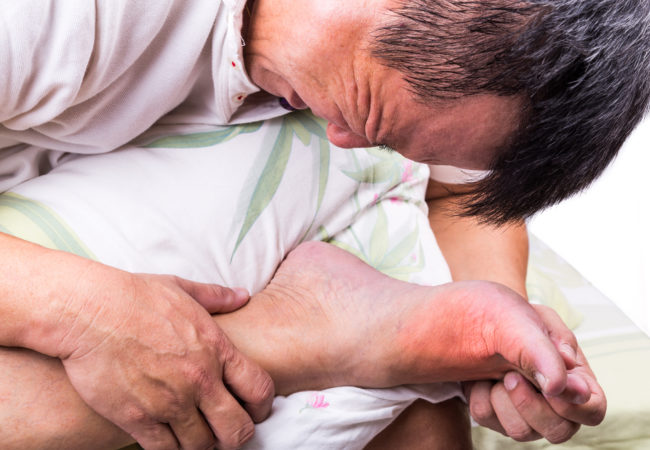
 Gout is an inflammatory joint illness that is a result of enhanced uric acid levels in the blood. It leads to the formation and deposition of monosodium urate crystals in joints, soft tissues, and kidneys. This deposition sets off sudden, intense attacks of joint pain, swelling, redness, and inflammation.
Though any joint in the body can be affected by gout, the joint at the base of the big toe is more prone to be affected in a majority of the cases. Normal uric acid levels in blood are 3.5 to 7.2 mg/dL. Uric acid levels more than this indicates hyperuricemia (high uric acid). Raised uric acid is not a disease and thus not dangerous. However, if excess uric acid levels lead to the formation of crystals in between the joints, gout can develop.
In some people, enhanced uric acid levels also lead to the formation of kidney stones. Please remember, not everybody who have high levels of uric acid, develop gout. High levels of uric acid in blood without any symptoms is termed as asymptomatic hyperuricemia.
Managing Gout Naturally with Homeopathic Medicines
Homeopathic remedies offer a very effective treatment for various complaints related to the joints, including gout. These medicines can be a big boon for all those who suffer from high uric acid and gout. Homeopathic medicines, along with proper dietary plan, can lead to remarkable recoveries in cases of gout. Homeopathic medicines for gout help relieve symptoms like tenderness, stiffness, pain, and also reduce the accompanying factors like swelling and inflammation in the joints. These medicines reduce overproduction of uric acid in the body and, where the need be, it accelerates the removal of this waste product through the kidneys.
In the mainstream medicines, NSAIDs (non-steroidal anti – inflammatory drugs) and corticosteroids are used to treat gout. These medicines offer a temporary relief and also tend to cause side-effects due to prolonged use. On the other hand, homeopathic medicines do not have any adverse effects and help in long-term relief and cure with regular medication as guided by a qualified homeopath.
Managing Acute and Chronic Gout with Homeopathy
Homeopathic medicines offer help in both acute and chronic gout cases. Initially, they treat an acute attack of gout. Following this, the homeopathic treatment helps treat the chronic tendency of gout. With these medicines, there is a gradual decrease in severity and frequency of gout attacks. And with further treatment, a permanent cure occurs in most of the cases.
Individualized Homoeopathic Medicine
Homeopathy is a symptom-based science, homeopathic medicines for gout are administered as per the characteristic symptoms in every individual. After medicine selection, the potency, dosage and repetition is decided given the uniqueness of the symptoms being presented. It is best advised to get every case of gout evaluated by a homeopath for correct prescription and best results. Self-medication is a strict no. These medicines offer relief in the cases of gout very gently.
Top 9 Homeopathic Medicines for Gout
The top nine homeopathic medicines for treating gout are Colchicum Autumnale, Benzoicum Acidum, Ledum Palustre, Urtica Urens,Lithium Carbonicum , Bryonia Alba, Lycopodium Clavatum , Berberis Vulgaris and Guaiacum Officinale.
1. Colchicum Autumnale – Top Grade Medicine For Gout
Colchicum Autumnale is the most frequently prescribed medicine for gout. It is an unfailing medicine that provides speedy relief from soreness, pain, and swelling of the joints from gout. It is an effective medicine to manage gout in almost any of the joints but particularly the one that affects the big toe. Severe pain, swelling in the big toe is felt in cases who need this medication. The big toe is very tender, sore and hot, even a slight touch on the toe is unbearable. The pain aggravates on movement. Aggravation of toe pain in the evening is also noted in a few cases requiring this remedy. It can be administered for stiffness and swelling in the hands and the feet from gout. This medicine can even be administered when several joints are affected by gout at the same time.
When to use Colchicum Autumnale?
It is a very effective medicine for managing gout with marked swelling, pain, and soreness, especially affecting the big toe.
How to use Colchicum Autumnale?
The potency of this medicine differs from case to case from low to high. Low potencies like 30C can be administered twice or thrice daily. Use of high potency like 200C should be limited to once daily.
2. Benzoicum Acidum – For Gout Affecting Knee Joint And Big Toe
Benzoicum Acidum is a wonderful remedy for gout that affects the knee joint and the big toe. For those who need it, the knee joint is painful and swollen, and there is a cracking noise in the joint when it is moved. In some cases, nodes from the deposits of urate crystals may be present on the knees. Benzoicum Acidum also works wonders in cases of knee pain that aggravates after drinking wine. Other than the knee, it is also beneficial for pain in the big toe joint. It is administered when the pain in the big toe gets severe at night. It occurs in the big toe mainly on the right side. Tearing or stitching pain is felt.
When to use Benzoicum Acidum?
It is the best choice of medicine for managing gout of knee and big toe with pain, swelling and sometimes node formation.
How to use Benzoicum Acidum?
One may take it in 30C potency one to two times daily depending on the intensity of the complaint.
3. Ledum Palustre – For Gout Affecting Ankle, Hands And Feet
Ledum Palustre is the most suitable medicine to manage gout that affects ankles. It is administered if there is swelling and pain in the ankle that extends upwards in the leg. The gouty pain aggravates in the evening as well as with movement. Ledum Pal is also helpful for treating gout that affects the toes and the feet. Tearing pain is felt in the toes. It is administered if gout starts in the joints of lower limbs and later affects joints in the upper body. In the case of gout of the hand, it is administered when nodes form on the hand and the finger joints. A drawing type of pain in the affected hand is felt.
When to use Ledum Palustre?
This medicine is administered for those cases of gout that affect the ankles, hands and feet especially when the pain worsens in the evening and from any movement.
How to use Ledum Palustre?
This medicine works wonders in 30C potency and can be administered two to three times daily.
4. Urtica Urens – For Gout of Wrist and Ankle
It is an important medicine in homeopathy for cases of gout affecting the ankle and the wrist. It is equally effective for acute and chronic cases of gout. This medicine is also used for dissolving kidney stones.
When to use Urtica Urens?
This medicine is an undoubtedly effective medicine for treating gout affecting the ankle and the wrist in both chronic and acute cases.
How to use Urtica Urens?
It is mostly preferred in Q (mother tincture) form that can be administered one to two times daily.
5. Lithium Carbonicum – For Gout Affecting Small Joints
Lithium Carbonicum is especially administered in gout associated with a uric acid diathesis. It suits cases with gouty pains in small joints, particularly toes, fingers and ankles, often with nodular swellings and stiffness. There is marked pain in the ankle joints while walking and pain in the hollow of the foot radiating up to the knee. Tenderness and swelling of the affected joints are prominent, and the pains are characteristically relieved by very hot water.
When to use Lithium Carbonicum?
It is administered for gout affecting the small joints and ankles; the pain is relieved by warm applications.
How to use Lithium Carbonicum?
It can be administered in 30C potency once a day.
6. Bryonia Alba – For Gout When Pain Worsens From Slightest Motion
Bryonia Alba is administered for gout when joint pain worsens from the slightest movement. It is most helpful when there is redness, pain, heat and swelling in the joints, especially in the feet. Other than movement, pain aggravates from touch. The nature of pain is sharp, tearing or stinging in nature.
When to use Bryonia Alba?
This medicine is a good option to deal with cases of gout when the joint pain aggravates from the slightest movement of the affected joint.
How to use Bryonia Alba?
It can be administered in 30C potency up to 3-4 times daily.
7. Lycopodium Clavatum – For Gout Affecting Heel
This medicine is well indicated for gout that causes pain in the heel. There may be worsening of heel pain while walking. A sensation of stone under the heel is felt. Along with this, profuse sweat and cold is felt on the feet. Lycopodium is also administered for cases of chronic gout where chalky deposits have formed in the joints.
When to use Lycopodium?
It is an excellent remedy for cases of gout that affects the heel with marked pain along with the sensation of stone under the heel.
How to use Lycopodium?
Lycopodium should be administered 30C once daily.
8. Berberis Vulgaris – To Manage Kidney Stones From High Uric Acid
Berberis Vulgaris is a top medicine for treating kidney stones due to high uric acid. It helps dissolve kidney stones. It is administered if pain is around the kidneys. The pain may radiate down to the urinary bladder from the kidney area, along with a stinging, and burning sensation in the kidneys. The urine may also contain sandy or slimy sediments. Though, it can be used for kidney stones on any of the sides, it is mostly indicated for kidney stones on the left side.
When to use Berberis Vulgaris?
Its use can be considered to treat kidney stones linked to high uric acid and pain in kidney region radiating down to the bladder.
How to use Berberis Vulgaris?
It is used mostly in mother tincture (Q) form that can be administered two to three times daily.
9. Guaiacum Officinalis- Gout with severe tearing pains
Guaiacum is well administered in gout if tearing, stitching pain and marked stiffness is felt in the joints. The affected joints are extremely painful, swollen, and intolerant to pressure, with a sensation of heat in the limbs. Gouty pains are often tearing in nature, associated with contractions and stiffness that doesn’t let one move. The condition is aggravated by heat, movement, wet, and cold weather, while relief is comes from cold applications, pressure, and stretching or movement of the limbs.
When to use Guaiacum Officinalis?
It works wonders in gout with intense tearing pain.
How to use Guaiacum officinalis?
It can be administered in 30C potency once a day. Higher potencies such as 200C or 1M can be used only under the guidance of a qualified homoeopath.
Types of Gout
1. Acute Gout: Sudden onset of severe joint pain, swelling, redness, and warmth, most commonly affecting the big toe (podagra).
2. Chronic Gout: Develops after repeated acute attacks, with persistent stiffness, joint pain, and possible joint damage.
3. Intercritical Gout: Symptom-free period between acute gout attacks when the patient feels normal, but uric acid levels may remain high.
4. Tophaceous Gout: Advanced stage marked by deposition of urate crystals (tophi) around joints, fingers, ears, or toes that leads to deformity.
5. Asymptomatic Hyperuricemia: Elevated uric acid levels without joint pain or inflammation that may later progress to gout.
Signs And Symptoms Of Gout
Gout symptoms occur due to the deposition of uric acid crystals in the joint spaces and or in the connective tissue of the joints. The main signs and symptoms are as follows:
1. Pain in joints: Gout is a very painful condition, mainly affecting the metatarsal– phalangeal joint at the base of the big toein most cases. Gout affecting big toe joint is named podagra. Pain occurs suddenly and in most cases, joint pain starts during the night and reaches maximum within 12 hours of its beginning.
Joints Affected
Gout mainly affects the joint (metatarsal–phalangeal joint) at the base of the big toe but it can affect other joints as well. The other joints that can be affected by gout include ankles, heels, knees, wrists, elbows, fingers, and shoulders.
Duration of a Gout Attack
One episode of gout can last from 3 days to two weeks. In between two gout attacks, no symptoms occur at all.
2. Swelling, Redness and Heat in Joints
3. Tenderness of the Joint: Joint is painful even to slightest touch, even the little contact with bedsheet seems unbearable.
4. Stiffness of the Joint and limited range of motion of joint
5. Tophi: Deposits of hard, painless deposits of uric acid, called tophi can appear as lumps under the skin and around the joints from long-standing increase in uric acid levels.
Causes And Risk Factors
The main cause of gout is an increase in uric acid levels in the blood.
The following factors increase risk of gout
1. Dietary factors: Eating food products rich in purines tend to raise the levels of uric acid in the blood. Some foods that are high in purines include meat, fish, seafood, shrimp, shellfish, beans, dried mushrooms, and spinach. Besides excessive alcohol, intake is strongly linked with an increased risk of gout. Drinking sugar-sweetened beverages are also linked with gout.
2. Some medical conditions make a person susceptible to gout. These include kidney disease, metabolic syndrome (It is a group of conditions including hypertension, abdominal obesity, and insulin resistance and abnormal lipid levels), psoriasis, haemolytic anemia, diabetes and hypertension.
3. A positive family history of gout increases risk
4. Obesity also increases susceptibility
5. Males are at higher risk of developing gout as compared to females. In females, chances are more of developing gout after menopause.
6. The use of certain medicines, like thiazide diuretics, is linked with gout attacks. Some other medicines associated with gout attack are aspirin, beta blockers, immunosuppressive drugs ciclosporins and excessive use of vitamin D supplements.
7. Recent surgery or a physical trauma
Pathophysiology
In our body, when purines (present in certain food and drinks) break, then uric acid is formed. This uric acid is expelled via kidneys in urine. Gout occurs when there is an increase in the uric acid levels in the blood. Uric acid levels increase either due to its overproduction (in 10% of cases), or decreased elimination of the uric acid from the body by the kidney (this is cause in 90% of the cases). As a result of increased uric acid levels in blood, uric acid crystals (known as as monosodium urate crystals) start accumulating in joints and soft tissue around it. These are sharp, needle-like crystals that trigger an inflammatory response, resulting in gout.
Complications Of Gout
1. A person may get recurrent attacks of gout each year
2. Joint erosion, damage and destruction
3. Formation of tophi (nodules under skin from deposits of urate crystals) that can form in any area like fingers, feet, hands and Achilles tendon. Tophi become tender during gout attack, at other times, are entirely painless.
4. In some cases, urate crystals tend to accumulate in urinary tract, leading to kidney stones.
Diagnosis And Investigations
1. Uric acid levels in blood: It is the most common test recommended in case of gout in which levels of serum uric acid are in blood are found to be elevated in gout. But its role in confirming gout is limited, as it is seen that many people have high uric acid level in blood but do not have gout, while some people have gout but their blood uric acid levels are normal.
2. Synovial fluid test: In doubtful cases, this test is suggested as it gives confirmatory diagnosis of gout. In this test, fluid from the affected joint is drawn with needles and checked under microscope. In case of gout, urate crystals are seen in this fluid.
3. Ultrasound of joint: It may help to check urate crystals in joint.
4. X-ray of joint: It may not be helpful in acute cases but in chronic cases, it may show joint erosions.
Management
The management of gout focuses on reducing uric acid levels, relieving pain, and preventing recurrent attacks through a holistic homeopathic approach. Diet plays a crucial role; purine-rich foods such as red meat, certain seafood, organ meat, alcohol (especially beer), and sugary drinks should be avoided. Whole grains, fresh fruits, vegetables, nuts, low-fat dairy products, and proper hydration should be encouraged to help eliminate uric acid. Regular, moderate exercises like swimming, walking, or cycling helps maintain a healthy weight and improves joint mobility, though strenuous activity should be avoided during acute attacks. Lifestyle measures such as adequate rest, weight control, stress management, are equally important, as sudden weight loss and stress can trigger flare-ups. During acute episodes, rest and proper care of the affected joint are also important.
Frequently Asked Questions
1. Can diet alone control gout?
Diet plays an important role, but complete control often requires lifestyle modification and medical or homoeopathic treatment based on the unique symptoms of the individual.
2. Can gout recur after treatment?
Yes, gout is prone to recurrence if uric acid levels remain high or triggers are not controlled.
3. Is alcohol harmful in gout?
Yes, alcohol—especially beer—increases uric acid levels and can trigger gout attacks.
4. Can homoeopathy help in gout?
Homoeopathy aims to manage gout by reducing uric acid tendency, relieving joint pain, and preventing recurrence, with treatment individualized for each patient.
5. Can stress trigger gout attacks?
Yes. Emotional and physical stress can enhance uric acid levels and precipitate acute gout attacks.
6. Is homoeopathy useful in chronic or recurrent gout?
Yes, homoeopathy is especially beneficial in chronic and recurrent gout. It aims to reduce the frequency and severity of the attacks and prevent long-term joint damage.
7. Is self-medication advisable in homoeopathic treatment of gout?
No. Gout requires individualized remedy selection and potency adjustment, so treatment should always be taken under the guidance of a qualified homoeopathic physician.
8. Homoeopathic can be combined with conventional treatment?
Yes, it can be taken along with conventional medicine. Maintain a gap of 10-15 minutes between both the medicines.
9. Are homoeopathic medicines safe?
Yes, homoeopathic medicine are absolutely safe and non-habit forming. It should be initiated under the guidance of a qualified homoeopath.
10. Is gout a lifelong condition?
Gout can be curbed with proper treatment, diet, and lifestyle changes.