
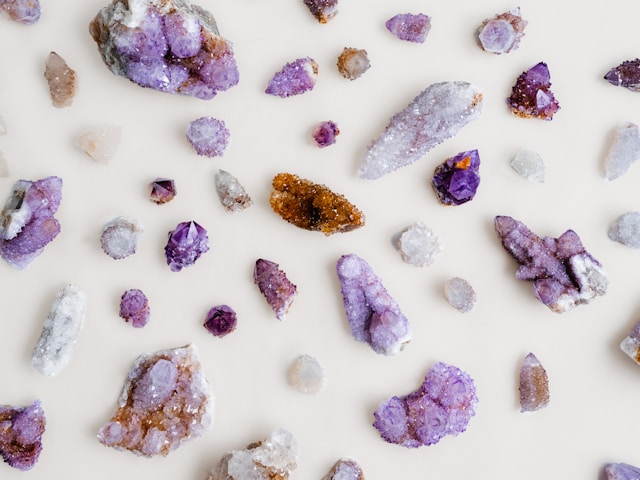
Crystals have quietly become part of the wellness backdrop. They sit in studio windows, on desks, and in gift shops next to candles. Most people who own one could not say exactly why they bought it. That vagueness is worth taking seriously rather than mocking.
The underlying belief is far more mainstream than the label suggests. Pew Research Center found that 42% of US adults believe spiritual energy can be located in physical objects such as crystals or mountains. That places it among the most widely held New Age beliefs measured in the US. This article is about that belief and the evidence around it, not about treatment.
How Did Crystals Reach The Wellness Aisle?
The route was commercial before it was spiritual. Crystals photograph beautifully, cost little to stock, and need no regulatory approval as decor. Retailers noticed all three facts at roughly the same time. Social media did the rest of the work.
The wellness category absorbed them easily because the category is broad. It already held candles, journals, sound bowls, and weighted blankets. Most of those items are bought for atmosphere rather than outcome. A crystal on a shelf is doing much the same job.
Three things made the category easy to stock:
- Unit costs are low and shelf life is unlimited.
- No regulatory approval is needed to sell decor.
- The products photograph extremely well online.
What Do Americans Actually Believe?
The survey picture is consistent and fairly stable. Pew’s research found that 62% of US adults hold at least one of four New Age beliefs it measured. Belief in spiritual energy within objects sits at 42%, and belief in psychics at 41%. These are not fringe positions in the United States.
The demographic split is also well documented. Around 70% of women hold at least one such belief, compared with 55% of men. Pew also found that self-identified Christians are about as likely as the religiously unaffiliated to hold them. Belief in this space cuts across religious lines rather than following them.
Interest in related practices follows the same pattern. Coverage of what people look for in a psychic reading reflects how mainstream that curiosity has become. The demand is genuine and easy to measure. Whether the practice works is a separate question entirely.
What A Crystal Actually Is
Geologically, a crystal is a solid with atoms arranged in a repeating lattice. Quartz, amethyst, and calcite are ordinary minerals formed under heat and pressure. Museum collections such as the minerals and gems research collection at the American Museum of Natural History hold hundreds of thousands of specimens. Their scientific interest is structural and geological.
Some crystals do have measurable physical properties. Quartz is piezoelectric, which is why it appears in watches and older radio equipment. That property involves tiny electrical charges under mechanical stress. It has no established connection to human health.
The 3 most commonly sold stones are ordinary minerals:
- Quartz, a silicon dioxide found on every continent.
- Amethyst, a quartz variety colored by iron traces.
- Calcite, a carbonate mineral common in limestone.

What Does The Evidence Say?
This is where the framing has to be careful. There is no scientific evidence that crystals hold energy or affect physical health. No credible body has found a therapeutic effect. Anyone selling one as a treatment is making a claim the research does not support.
Researchers who have looked at reported effects attribute them to expectation. Studies have found people report similar sensations from imitation crystals as from genuine ones. Coverage of research from bodies such as the Association for Psychological Science regularly documents how strongly expectation shapes reported experience. The effect is real; the mechanism is psychological.
Why The Placebo Explanation Is Not A Put Down
Saying something is placebo is often heard as an insult. It should not be. Expectation genuinely changes how people report feeling, and that is a well studied phenomenon. The finding is about human psychology, not about the stone.
It also explains the appeal honestly. Holding a small object during a deliberate pause is a cue to slow down. The pause is doing the work, and the crystal is the reminder. That is a reasonable thing to want from a desk ornament.
Where This Leaves A Wellness Routine
The practical guidance is simple and fairly boring. Enjoy the object, keep your expectations modest, and do not let it replace anything. Nothing in the survey data suggests crystals do anything physiological. Nothing in the evidence suggests they are harmful either, as decor.
A few sensible boundaries keep this in proportion:
- Treat a crystal as decor or a ritual cue, nothing more.
- Never use one in place of prescribed treatment.
- Be wary of any seller making health claims.
- Take persistent symptoms to a qualified clinician.
The genuine risk is not the stone. It is delaying real care because something on a shelf felt reassuring.
The Part Of The Trend That Does Hold Up
There is a defensible version of all this, and it is about behavior. People who buy crystals are usually trying to build a small deliberate pause into a busy day. That instinct shows up across the wellness category. Interest in nature based breaks for modern wellbeing points at the same underlying want.
The pause is the part with actual support behind it. Rest, attention, and a break from screens are all reasonably well evidenced. None of that requires a mineral. If an object helps you remember to stop, it has earned its shelf space on those grounds alone.
Frequently Asked Questions About Crystals And Belief
How Many Americans Believe In Crystal Energy?
Pew Research Center found 42% believe spiritual energy can be located in physical objects. That includes crystals and natural features such as mountains. It is among the most widely held New Age beliefs measured.
Is There Any Scientific Evidence for Crystal Healing?
No. There is no scientific evidence that crystals have healing or energetic properties. Reported effects are attributed to expectation and the placebo response.
Why Do Crystals Seem to Work for Some People?
Expectation strongly shapes how people report feeling. Studies find similar reported sensations from imitation crystals. The pause and the intention appear to matter, not the mineral.
Are Crystals Safe to Keep Around the House?
As decor, they pose no particular issue. The concern is using one instead of proper medical care. Persistent symptoms always warrant a qualified clinician.