
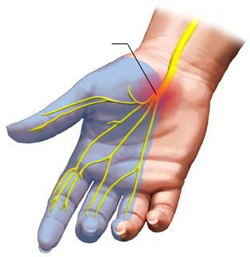

Carpal Tunnel Syndrome (CTS) is a very common medical condition affecting the hands. It is caused by the compression of the median nerve as it passes through the carpal tunnel in the wrist. It is also called median nerve compression or median nerve entrapment. It results in symptoms like numbness, tingling, pain, weakness in the thumb and fingers including the index finger, middle finger and half of the ring finger on the side close to the thumb and the palms of hands. CTS is one of the most common entrapment neuropathies characterized by the compression of one of the peripheral nerves of the body.
Homoeopathy offers a very effective treatment option in treating cases of carpal tunnel syndrome. Homeopathic medicines help in providing long-term relief in symptoms of CTS magnificently as they target the root cause behind it. The CTS symptoms mentioned above get relieved very effectively. Unlike conventional treatments which recommend NSAIDs (non-steroidal anti–inflammatory drugs) or corticosteroids for CTS treatment, homeopathy is safe, non-habit forming and ensures long-term relief.
An effective homeopathic treatment for Carpal Tunnel Syndrome (CTS) can save a person from the surgeon’s knife. However, the results will depend on the severity and stage of the CTS. In mild to moderate cases, where the wasting (thinning from severe and prolonged nerve compression) of the nervous muscles has not taken place, the chances of recovery are higher.
Homeopathic medicines for CTS are prescribed individually in every case as per the symptom presentation. A detailed case history is taken followed by an assessment of symptoms to provide the best suitable homeopathic medicine. Homeopathy works wonders when the medicine is prescribed following this individualized approach.
Homeopathic remedies for CTS are sourced from naturally occurring substances and hence are very safe to use without any side effects. These medicines boost the body’s self-healing mechanism to overcome CTS naturally.
Top 10 Homeopathic Remedies for Carpal Tunnel Syndrome
The main medicines for treating Carpal Tunnel Syndrome are Causticum, Ruta Graveolens, Hypericum Perforatum, Arnica Montana, Rhus Toxicodendron, Bellis Perennis, Kali Carbonicum, Phosphorus, Zincum Metallicum and Calcarea Fluorica.
1. Causticum – Top Grade Medicine for Carpal Tunnel Syndrome
Causticum is ranked the best medicine to treat cases of CTS. I have treated many cases (successfully) with Causticum. The key indications to use this medicine are weakness in the hands, and numbness and pain in the fingers. It is especially recommended when the Carpal Tunnel Syndrome has reached a level where there is excessive weakness in the hands and the muscles of the hand have atrophied (means thinning out). Causticum should be administered in cases of CTS if the palmar side of the hand has a flat appearance (reduction in the musculature of the hand).
When to use Causticum?
Causticum is the best treatment to manage numbness, weakness and pain in fingers in cases of CTS. Its is also suggested for cases where the muscles of the hand have started wasting out, means thinning from severe and prolonged nerve compression.
How to use Causticum?
One may take Causticum 30C once or twice in a day at the beginning of treatment.
2. Ruta Graveolens – For CTS from Strain in Wrist, Tendonitis or Wrist Fracture
Ruta Graveolens, sourced from plant Rue-Bitterwort, is one of the best medicines to treat Carpal Tunnel Syndrome. It is mostly recommended where symptoms occur due to overuse of the wrist, tendonitis or after a sudden strain or fracture of the wrist. There is marked pain and stiffness in the wrist and hand, along with great restlessness.
When to use Ruta Graveolens?
Ruta is the best medicine to manage CTS arising from the overuse of the wrist and also from inflamed tendons or a sudden strain on the wrist.
How to use Ruta Graveolens?
Initially one may take it in 30C potency once or twice a day, though it is recommended in high potencies also which must be taken after consulting a homeopathic doctor.
3. Hypericum Perforatum – For CTS triggered by an Injury (Damaging Median Nerve)
Hypericum Perforatum is highly effective in cases when there is a nerve injury which leads to the onset of Carpal Tunnel Syndrome. The injury damages the median nerve leading to symptoms such as numbness, tingling and burning pain in fingers and hands that can be treated wonderfully by using this medicine.
When to use Hypericum Perforatum?
This medicine should be highly preferred in CTS cases to manage numbness, tingling, burning in fingers post nerve injury.
How to use Hypericum Perforatum?
Hypericum 30C can be used three to four times a day as per the severity of the symptoms.
4. Arnica Montana – For CTS from Injury or Overuse of Wrist
This remedy is very useful in treating cases of CTS due to injury or the overuse of the wrist. It is administered when there is pain in the hands. Besides, there is tingling sensation in arms and the hands. This medicine helps heal the injury and removes effects of the worst kind of overuse of wrist, with resultant symptom relief. One of the indicating factors for the use of Arnica is soreness of the wrist after overexertion.
When to use Arnica Montana?
This medicine should be administered as the first line of treatment in cases of CTS arising from an injury or overuse of the wrist.
How to use Arnica Montana?
It is safe to administer it in 30C potency at the very outset, one to as many as three times a day. However, for higher potencies like 200 C or more, consult a qualified homeopath.
5. Rhus Toxicodendron – When Wrist Inflammation or Overuse Triggers CTS
Rhus Toxicodendron is a very effective medicine in cases of CTS that follows the overuse of the wrist and hands causing strain or wrist joint inflammation (arthritis). The overuse of hands or wrists may occur from excessive typing on computer, car driving, and sewing to name a few. Those who need Rhus Tox have pain and tenderness in the wrist. Any pressure exerted on the wrist is unbearable. There is numbness in the fingers, especially in the middle finger and the index finger in the morning hours.
When to use Rhus Toxicodendron?
Rhus Tox is administered to manage tenderness and pain in the wrist in those cases of CTS related to inflamed wrist joint or the overuse of wrist.
How to use Rhus Toxicodendron?
From its various available potencies, it is advisable to begin with 30C potency two to three times daily for best possible results. Potency can be raised to 200C or 1M but only after consulting a homoeopathic physician.
6. Bellis Perennis – For CTS Related to Repetitive Strain Injury
Apart from the above-mentioned medicines for CTS linked to repetitive strain injury, Bellis Perennis can be administered as well. The characteristic symptoms indicating its use is a contracted feeling in the wrist. There is a feeling as if an elastic band has been tied around the wrist and squeezing it.
When to use Bellis Perennis?
This medicine is prescribed in those cases of CTS if there is repetitive strain injury to the wrist alongside symptoms of contracted sensation in the wrist.
How to use Bellis Perennis?
Bellis Perennis can be taken in 30C potency two to three times daily for best possible results.
7. Kali Carbonicum – For Stitching, Lancinating Pains In Hands and Wrists
Kali Carbonicum is one of Schussler’s tissue salts, helping in treating cases of CTS. It is administered when there are sharp, stitching, or shooting pains in the hands and wrists, often extending to the fingers. The hands feel tired, weak, and heavy, with a tendency to drop objects unintentionally due to reduced grip strength. Numbness and tingling may be present, especially after prolonged use of the hands. Symptoms typically aggravate in the early morning hours (around 3–5 am) and from exposure to cold, while gentle warmth may bring relief. The patient complain of stiffness when one moves about. However, there is gradual ease after continued motion.
When to use Kali Carbonicum?
Kali Carbonicum is administered when symptoms reflect deep-seated nerve involvement with marked weakness and sharp, stitching pains.
How to use Kali Carbonicum?
It is recommended in 6X potency to begin with, and the potency can be raised to 30C & 200C but only after consulting a qualified homoeopath.
8. Phosphorus – For Burning, Tingling and Numbness in Hands and Fingers
Phosphorus is a very useful remedy when there is prickling, burning and crawling sensation in the wrists and fingers, often accompanied by weakness and number felt in the grip. The patient may complain that the hands feel dead or asleep, especially at night or on waking in the morning. Symptoms mostly worsen due to heat, pressure, and at night, and may be aggravated by overuse of the hands. There is often a sensation of internal heat or burning felt along the nerve course, reflecting phosphorus’ deep action on the nervous system.
When to use Phosphorus?
When symptoms point towards noticeable nerve sensitivity with tingling, burning, and numbness of the fingers and hands, use of Phosphorus is considered to be the best.
How to use Phosphorus?
The use of this medicine should be limited to one or two times daily in 30C potency.
9. Zincum Metallicum – For Nerve Exhaustion from Prolonged Strain
Zincum Metallicum is administered when there is tingling, numbness, and crawling sensation felt in the fingers and the hands, often accompanied by a feeling of weakness and exhaustion of the nerves. The patient may complain that the hands feel restless, with an inability to keep them still, especially during periods of physical and mental fatigue. Pain and numbness typically aggravate from overuse, prolonged work, and nervous strain, and may be felt more at night. Grip strength is weakened, and fine motor activities become difficult due to nerve fatigue rather than inflammation.
When to use Zincum Metallicum?
Zincum Metallicum is administered when symptoms occur due to nerve exhaustion, prolonged strain, or suppressed discharges, leading to motor and sensory disturbances in the hands.
How to use Zincum Metallicum?
It can be used in different potencies according to the intensity of the symptoms from 30CH, 200CH and 1M. However, do consult a qualified homoeopath before raising the potency.
10. Calcarea Fluorica – For Chronic Wrist Stiffness and Weakness
It is administered in cases of CTS if there is stiffness, hardness and weakness of the wrist joint, where prolonged repetitive strain has led to thickening or loss of elasticity of ligaments and fibrous tissues. Patients complain of numbness, dull aching pain and stiffness, especially after use of hands for long hours. The wrists feel weak and give a sensation of instability. Symptoms generally aggravate in cold, damp weather and from rest, and improve slowly with gentle movement and warmth. Calcarea Fluorica suits cases where recovery is slow and the condition tends to relapse repeatedly.
When to use Calcarea Fluorica?
Calcarea Fluorica is administered in carpal tunnel syndrome if the condition is long-standing, chronic and structural in nature, involving tendons, ligaments, and connective tissue rather than acute swelling.
How to use Calcarea Fluorica?
It is administered in 6X potency, and should be taken two to three times daily for best possible results after consulting a qualified homeopath.
Causes and Risk Factors of CTS
Carpal Tunnel Syndrome occurs when the median nerve gets compressed or irritated in the wrist when it passes through the carpal tunnel. Carpal tunnel is a narrow tunnel (passageway) in the palmar side of the wrist through which the median nerve and tendons (total nine in number) pass. Tendons are bands of tissue that connect muscles to bones.
Risk factors
A variety of factors are linked to Carpal Tunnel Syndrome development as follows:
1. Repeated trauma (overuse injury) to the tissue inside the carpal tunnel:It is common to find Carpal Tunnel Syndrome in people who perform repetitive movements of hands and the wrist frequently. Carpal tunnel is very common in people who work on computers. Typing is one of the most common causes that lead to Carpal Tunnel Syndrome. Certain mechanical jobs that repeatedly strain the wrist may lead to the development of CTS, for example driving vehicles, sewing, using hand tools (especially the ones that vibrate – carpenters are at high risk of developing CTS), writing, knitting, playing piano and other musical instruments.
2. Arthritis (joint inflammation) in wrist joint: Medical ailments like rheumatoid arthritis and gout can also lead to CTS. The swelling and inflammation related to these conditions can reduce the carpal tunnel space and compress the median nerve.
3. Wrist injury/fracture/dislocation
4. Having a small carpal tunnel
5. Tendonitis: Inflammation of any among the nine tendons of carpal tunnel can occur and compress the median nerve.
6. CTS is common in females as compared to males. Women are three times more at risk of CTS as compared to men. The reason could be a smaller carpal tunnel in women as compared to men.
7. Certain medical conditions also predispose a person towards the development of Carpal Tunnel Syndrome. These are diabetes (it increases chances of nerve damage), hypothyroidism and high blood pressure.
8. Obesity, alcoholism, smoking, excessive salt intake also increases risk of CTS
9. Having a family history of CTS
10. Pregnancy and menopause: Here retention of fluid contributes to CTS by raising pressure in the carpal tunnel and causing irritation in the median nerve.
11. Use of certain medicines, like anastrozole, which is used for treating breast cancer
12. A tumor in the carpal tunnel
Stages of Carpal Tunnel Syndrome
Stage 1- Symptoms are often intermittent and mild, like numbness, tingling and pin needle sensation in fingers especially the thumb, index and middle fingers.
Stage 2- At this stage, symptoms become more persistent and frequent, it becomes painful with pain radiating to the forearm and elbow. The grip of hand starts getting affected at this stage.
Stage 3- Symptoms are constant and working with hands becomes significantly impaired at this stage. Muscle wasting sets in and hands become weak which makes it difficult to carry out daily activities.
Stage 4- Permanent nerve damage may occur if CTS is left untreated. This stage is irreversible and may require help of conventional methods. There is loss of sensation, marked wasting of muscles and sometimes, permanent disability.
Stage 1 and stage 2 CTS cases have the highest chances of recovery. If the person is in stage 3 or and 4, homeopathic medicines cannot reverse the damage already done to the muscle, but can work to halt further progression of muscle damage and provide symptomatic relief. Only in the severest of cases that do not respond to conservative treatment, surgery can be opted.
Investigations and Diagnosis of CTS
1. Nerve conduction study test: This is the main test to diagnose CTS. In this test, electrodes are placed on the hands and the wrist and a little shock is passed through the median nerve that measures the conduction speed of nerve impulses. A slower than normal nerve impulse in the carpal tunnel suggests the presence of CTS.
2. Electromyography: In this test, a thin needle is inserted into the muscle to check the electrical activity of muscles. It helps reveal the damage to the muscles that are controlled by the median nerve.
3. X-ray and ultrasound of wrist: An X-ray helps to rule out related conditions like arthritis or fracture though it cannot diagnose CTS. An ultrasound will help to examine bones and nerves of the wrist and check for nerve compression.
Frequently Asked Questions
1. I have numbness in fingers and hands, am I suffering from CTS?
No doubt that CTS is one of the most common reasons behind numbness in fingers and hands. But it can arise from several other causes too, for example, cervical neuropathy, brachial plexus injury, and Raynaud’s phenomenon. So I advise you to consult a doctor to find out the exact cause behind your complaint.

Thenar muscle
2. Does pain in fingers indicate CTS?
Pain in fingers is one of the symptoms of CTS but merely pain does not confirm CTS. In cases of CTS, numbness, tingling in fingers is usually present along with pain. If there is only pain in fingers, it could be due to other reasons as well, like arthritis, trigger finger, Dupuytren’s contracture, tendonitis, and ganglion cyst. So finger pain without numbness or tingling in fingers is usually not CTS.
3. How to know the difference between CTS and arthritis?
In case of CTS, there is numbness, tingling, pain and weakness in fingers and hands. In cases of arthritis, stiffness, swelling and pain is felt in the joints.
4. I am suffering from CTS; will the use of wrist splint help?

wrist splint
Though wrist splints cannot cure CTS as it requires proper treatment, a wrist splint can definitely help to relieve night-time symptoms of numbness and tingling in fingers and hands. Use of wrist splint is recommended at night as a person can unconsciously bend the wrist during sleep. Here the wrist splint will hold the wrist still and straight and relieve disturbing night-time symptoms.
5. I have Carpal Tunnel Syndrome, can I do typing?
Typing involves the constant use of wrist and hands and it can worsen CTS. If possible, avoid typing. But if your office work requires a lot of typing, make sure to press computer keys softly, use a comfortable computer mouse, place keyboard at elbow height, and take proper breaks at regular intervals in between typing to reduce strain on the wrist.
6. Will heat application on the wrist help CTS pain?
Yes, heat application can help in managing CTS pain. Heat enhances blood flow and relaxes the tense muscles and relieves wrist pain. Avoid it if your wrist is swollen or red.
7. What if CTS is left untreated?
CTS should be treated because it can lead to permanent nerve damage and muscle damage, if the problem is not addressed. This leads to loss of sensation and weakness in the fingers.
8. Why is my pain worse at night or early morning?
Symptoms often worsen at night because wrist positions during sleep increase pressure on the nerve.
9. Can carpal tunnel syndrome affect both hands?
Yes, it can affect one or both the hands, though generally one hand is affected more than the other.
10. What daily activities and lifestyle changes should I do or modify to manage CTS?
Avoid repetitive wrist strain, prolonged mobile use, maintain proper keyboard posture, and avoid heavy gripping activities. Proper ergonomics, wrist exercises, adequate rest, stress management, and maintaining overall health support recovery.
11. Is carpal tunnel syndrome related to neck problems?
Sometimes symptoms can overlap. Proper evaluation helps differentiate between wrist nerve compression and cervical issues.
12. Will rest alone cure carpal tunnel syndrome?
Rest helps in early cases, but long-standing symptoms usually need medical treatment along with lifestyle correction.
13. Why do my fingers feel numb while holding my phone or driving?
Bending the wrist for a long period increases pressure on the nerve, leading to numbness and tingling.
14. When does medical advice become necessary in CTS?
If symptoms persist, worsen, or interfere with daily activities like writing, cooking, or sleeping, medical consultation is advised.