
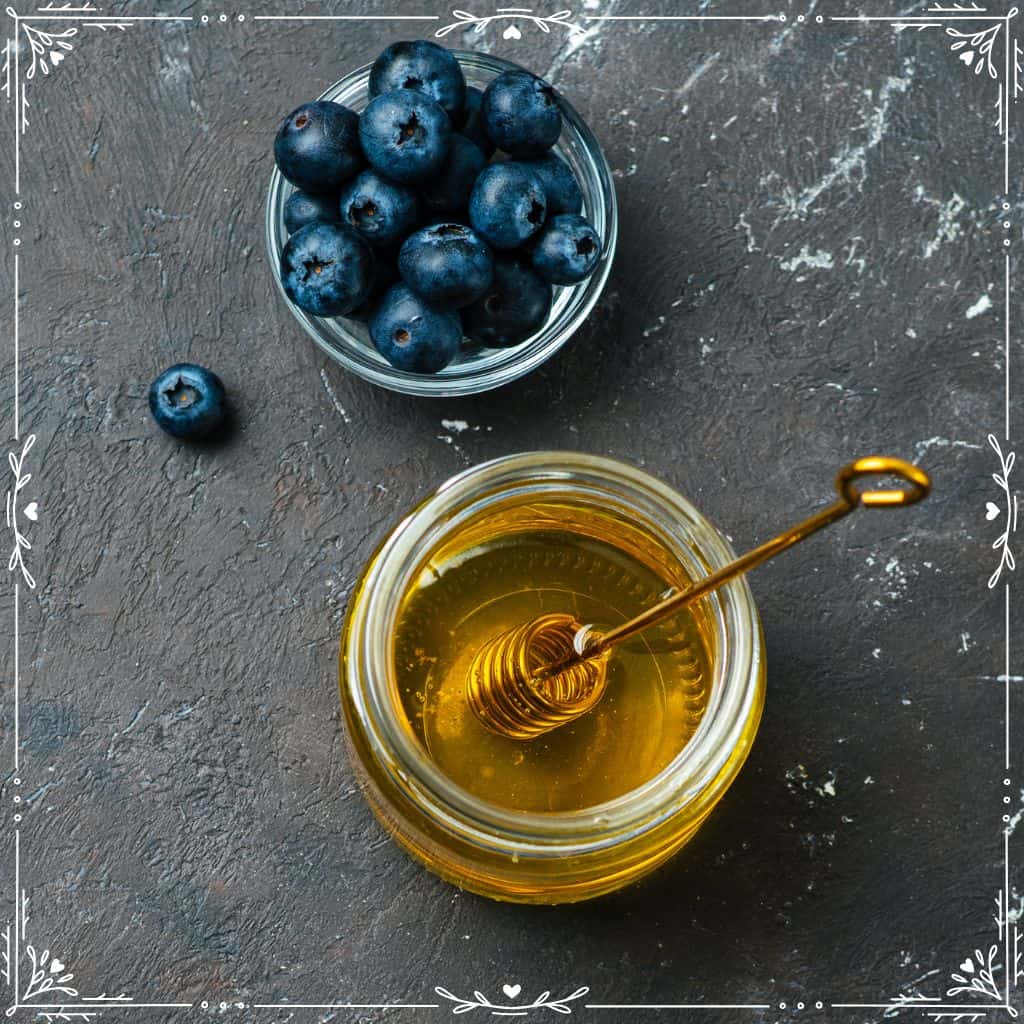
Step-by-step guide to making honey fermented blueberries
Making honey-fermented blueberries is incredibly easy. Here’s how I do it, based on years of seasonal foraging and cooking experiments.
Step 1: Add berries to a clean jar
Fill a clean glass jar about ¾ full with berries. I like to use a half-liter or a quart glass jar, depending on how much I have collected. Don’t pack them too tightly, leave room for stirring and bubbling.
Step 2: Pour in raw honey
Pour raw, unpasteurized honey over the berries until they are completely covered. The honey will slowly settle between the berries. You can stir gently with a wooden spoon or chopstick to help it along and remove air bubbles.
Step 3: Seal loosely and set aside
Cover the jar with a plastic lid, but don’t screw it on too tight, just enough to hold it in place while still allowing gases to escape. This helps prevent pressure from building up during fermentation. Then place the jar in a cool, dark place, out of direct sunlight, such as a pantry or cupboard.
Remark: If you are using a metal lid, make sure there is parchment paper between the pot and the lid. Prolonged contact with metal in a fermentation can corrode the metal and leach into your fermentation.
Step 4: Stir daily for the first week
Once a day for the first 5-7 days, turn the lid on the jar and gently turn it upside down so that the honey covers all the berries. This keeps everything well mixed and prevents mold from forming on the surface. When you return the jar to an upright position, be sure to loosen the lid to allow the gases to escape. You will probably see small bubbles forming; that’s a good sign that your fermentation is alive and active!
Step 5: Let it ferment
After the first week you can stir every few days. Fermentation will continue at room temperature for 2 to 4 weeks, depending on your environment and how spicy or bubbly you like the taste. Taste occasionally and trust your senses.
Step 6: Store in the refrigerator
Once you are satisfied with the taste, screw the lid on tightly and store the jar in a cool place. This slows down the fermentation process and helps preserve the berries. They will keep refrigerated for several months and the taste will improve over time.
Each batch turns out a little different, and that’s part of the fun. It is a living recipe, just like the wild places that inspire it.