
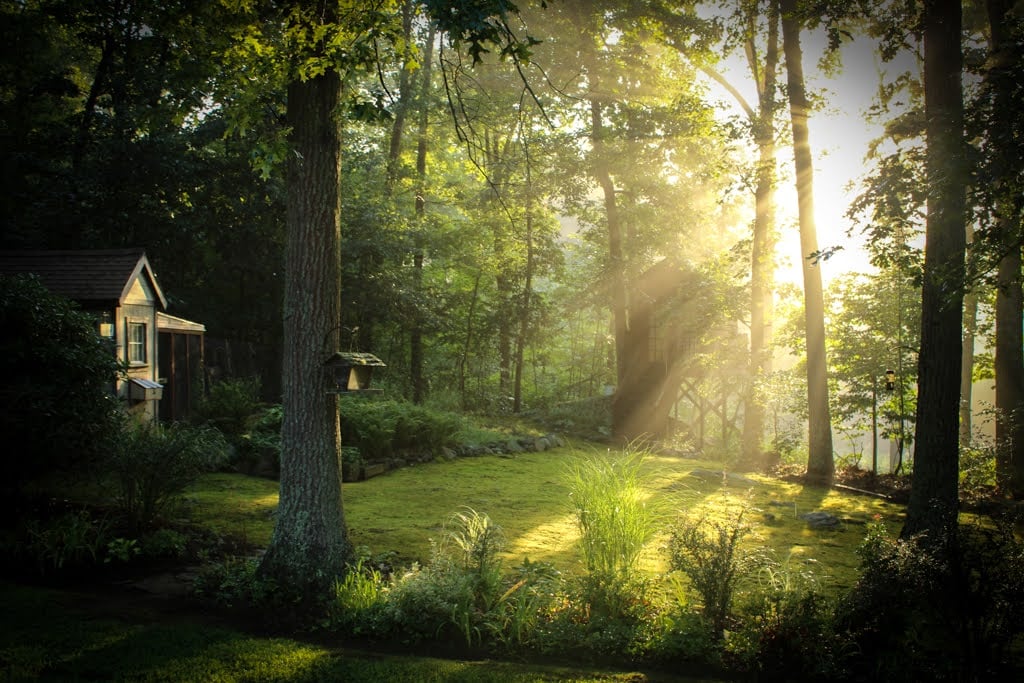
Oak in myths and folklore
Throughout time and culture, the oak has stood as a symbol of strength, endurance and connection to the divine. In Celtic traditions, the word druid is thought to be related to the oak tree – priests of the oak tree. The oak tree represented wisdom, protection and a living bridge between the human world and the spirit world.
The Normans associated oaks with Thor, the god of thunder, while the Greeks and Romans associated them with Zeus and Jupiter. Even their physical form reinforces this: Oak trees stretch towards the sky while digging deep roots into the earth, often acting as natural lightning conductors. In this way they become living channels between earth and sky, reminding us of our own potential to bridge the physical and the spiritual.
The oak also has deep connections to the idea of doorways and gateways. The month of January is named after Janus, the Roman god of transitions, thresholds and new beginnings. Oak trees were sacred to Janus, and in many traditions oak itself is the ‘door’ between worlds. The Sanskrit word for both oak and door is dwr, reflected in the Celtic Ogham word duir. Oak becomes not just a tree, but a doorway – a door that gives access to the heavens above and the sacred earth below. As above, so below. As within, as without.
From the same root we get the word druid, which combines dru (oak) with wid (to know or see) – literally ‘one who has knowledge of oak’. Even the word dryad, meaning tree spirit, comes from this lineage. In the Celtic Ogham alphabet, duir symbolizes strength, courage, will, nobility, masculinity and sovereignty. The oak is connected to the solar cycle and stands as the tree of vitality and sovereignty, opening the way between the solstices.
The ancient story of the Oak King and Holly King reflects this cycle. The Oak King comes to power after the winter solstice and rules the waxing year as light returns, while the Holly King takes over after midsummer, when the sun begins to wane. The oak thus embodies renewal, light and the eternal turning of the seasons.
Oak was also protected under pre-Christian Irish Brehon laws, which declared certain trees sacred and to be treated with reverence. These laws reflected a worldview that recognized forests as more than resources: they were sacred communities of beings. But colonization broke this reverence. In the 12th century the Normans introduced land ownership to Ireland and oak trees were felled as a commodity. Later, under the Tudor dynasty, Henry VIII and Elizabeth I ordered mass deforestation to build warships for the Royal Navy, destroying Ireland’s ancient forests as both punishment and exploitation.
Even earlier, the Romans had targeted and cut down sacred oak forests to subdue the Druids and expand their empire. And this tragic cycle continued across the pond: Colonists arriving in North America cleared about half of the Eastern Woodlands’ forests—including countless oaks—between 1600 and 1870, transforming entire ecosystems.
Despite centuries of destruction, the oak remains a survivor and still stands as a tree of reverence, strength and resilience. Sacred groves may have been felled, but the oak continues to embody the threshold between worlds, calling us to remember our connection to both the earth and the sky.
Beyond myth and history, oaks are also keystone species in the ecosystems in which they live. In the northeastern forests where I live, oaks provide food and shelter for more wildlife than any other tree genus. Their acorns feed deer, bear, turkey and numerous small mammals. Their branches harbor caterpillars that become food for migrating songbirds, and their canopies provide shelter for insects, fungi and mosses. Remove the oak and entire communities of plants and animals disintegrate. Honoring the oak means not only remembering its sacred stories, but also recognizing its continued role as the foundation of life itself.