
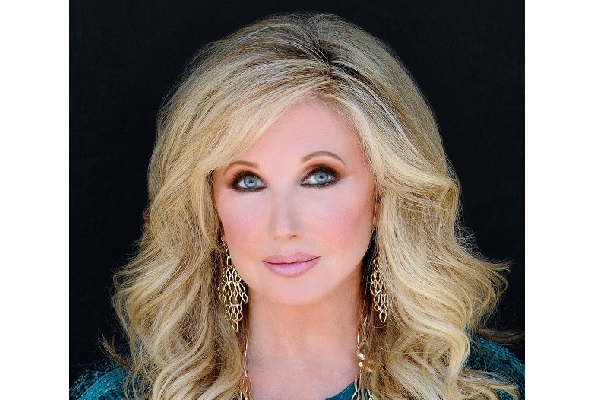
Morgan Fairchild is one of America’s best-known actresses. Daytime soap opera fans may remember her in Search for Tomorrow in the mid-70s. Her breakout television performance as Constance Weldon Carlyle in Flamingo Road (Golden Globe Best Actress nomination), was followed by Racine, one of her favorite roles, in Paper Dolls. Ms. Fairchild also starred in long-running television shows including Falcon Crest and Dallas. She broke ground playing Sandra Bernhardt’s lesbian lover on Roseanne and an appearance on Murphy Brown earned her an Emmy nomination. She was also seen several times on the hit sitcom Friends, playing the mother of Chandler Bing (Matthew Perry). Numerous film roles have also been a major part of her long acting career. Most recently, Ms. Fairchild appeared in the Ladies of the 80’s: A Divas Christmas—Five internationally-known, glamorous, 80s soap opera stars reuniting to share the spotlight and shoot the final Christmas episode of their long-running soap opera where they learn the meaning of the true Christmas spirit. The ensemble cast also included Loni Anderson, Linda Gray, Donna Mills and Nicollette Sheridan. For many years, she has also been an activist for social causes including AIDS and environmentalism. Interview by Sheldon BakerAM:
I learned you’re now part of the podcast world. Talk about that programming.
Ms. Fairchild: My sister and I were trying to determine something we could do together. She’s the one with the Juilliard degree, and she teaches acting in Texas. I’ve seen so many other folks getting into the podcast world and having so many Twitter, Blue Sky and Instagram followers that are interested in current events. I thought it would be a good thing to try, just having conversations with people. It seems like these days, a lot of people are feeling isolated and confused about what’s going on in the world. I get a lot of questions about some of that on my social media platforms. So, I thought it would be a good thing to try. So far, we’ve had fun. We’ve only produced two as of this interview, but we’re getting ready to do a third one with Donna Mills, my old buddy. We’re very excited.
AM: What is it called and where can we hear it?
Ms. Fairchild: It’s on Spotify and wherever you get podcasts. We titled it Two Bitches from Texas. It’s just us sitting around talking with our friends about how to save the world.
AM: By what you’re wearing, something tells me you’re a Rolling Stones fan.
Ms. Fairchild: I didn’t know we were going to be on camera for this interview. This is now my usual garb. Ever since COVID, I’m usually in leggings and my rock and roll t-shirts. I’ve got the Gucci’s in the closet most of the time these days.
AM: What else is on your current celebrity agenda?
Ms. Fairchild: I’ve been doing a bunch of autograph shows, and Comic-Cons. One was a three-day event in Dallas, that included most of the cast from Dallas, as well as Donna Mills, and Michelle Lee, and Joan Van Ark from Knott’s Landing, and Joyce DeWitt and Priscilla Barnes from Three’s Company. It was great to see everybody. Back in the day, we’d get together and say—who are you dating, where are you going, and what are you doing? Now we’re saying, oh, my hip replacement and—how are the grandkids? We’re still great friends and it’s always great to see everybody and tease each other a little.
AM: Would you consider your role in the daytime soap, Search for Tomorrow, as being your first big break?
Ms. Fairchild: When you’re a kid starting out everything is a big break. But that was my first real foray into television. I had done runaway productions in Dallas growing up there. I started in theater when I was only 10. I worked on Bonnie and Clyde when I was 16, as well as a lot of commercials. Because Texas was a right-to-work state, we would get the B-movies to come there to shoot. But yes, Search was my first kind of real breakthrough on television.
AM: You were in Dallas, then Falcon Crest for a short time. I believe Flamingo Road was a standout series for you. You received a Golden Globe nomination so that has to say a lot about you as an actor.
Ms. Fairchild: Flamingo Road was quite popular for NBC, even though it was only on for a couple of seasons. I was recently talking to Donna and Michelle about it over dinner saying they were all on CBS—Dallas, Knott’s Landing and Falcon Crest. We were on NBC and it was a big hit for that network at that time. But there was a change at the top and it was decreed no more soap operas on NBC, so we got canceled out of the blue. It’s one of my favorite Hollywood stories. We’d already been picked up. John Beck, who had a recurring role, bought a house in Santa Barbara. I purchased my first home in LA. This was both based on the fact we were picked up. Two weeks before we start shooting, I’m in the limo on the way to the airport to go to New York to do PR for the new season and I get a call from Entertainment Tonight. They asked, “How does it feel to have the show canceled?” I thought it was a joke. But it was not a joke. That’s Hollywood.
AM: Or as they say, that’s show biz.
Ms. Fairchild: It surprised everybody, because NBC was not number one at that point. It was pre-Cosby, and we were a big hit after one season.
AM: You appeared in several episodes of Friends playing the role of Matthew Perry’s mother. How well did you know him?
Ms. Fairchild: When he passed away, most of the world thought of me as his mom, so I was getting a ton of condolences. It was very hard. He was such a terrific young man, and a nice guy. To see what he went through, and people take advantage of his addiction issues was heartbreaking. I had thought he was doing better. I was not super close to Matthew, but I knew his dad. When they offered me the Friends role to play his mom, I remember Cecily Tyson telling me I was too young to be that guy’s mother. I thought you have to make that transition at some point.
I took the part, and the first day on the set, Matthew comes bounding over to me, like a big puppy dog. He said, “You probably won’t remember me. I used to hang out with you on the set of Falcon Crest and Flamingo Road with my dad. I said who’s your dad. He said, “John Bennett Perry, who had a recurring part as a sheriff on Flamingo Road and Falcon Crest.” I said you’re that kid? So, I guess I was old enough to be this kid’s mother.
Matthew was really a sweet guy, and so talented. It’s hard to see people struggle like they do. I’ve had a few people I loved in my life that have struggled with addictions of one kind or another, so I’ve been down that road with people I care about. It was difficult knowing what he was going through. I had offered to help and reached out to him. Because of previous relationships, I’d been around Al-Anon for a long time, so I’m familiar with the 12-step program. Al-Anon, for people who don’t know, is for the friends and family of an addicted person. I talked to him a little about it and said I was there and gave him my phone number if he wanted to talk or go to a meeting. I told him if he was scared to go to a meeting by himself, I’d go with him. But he never called. You can’t help people until they want to be helped.
AM: Many years ago, you wrote a book called Super Looks. It offered beauty and fashion advice. It’s still available on Amazon and eBay, I don’t know if you know that.
Ms. Fairchild: I didn’t know that.
AM: It is. Times have changed, and looking at today’s fashion and approaches to personal care and makeup, what are your thoughts?
Ms. Fairchild: Personal care products have gotten a lot healthier. No sulfates, or other nasty ingredients. The shoulder pads have gone down, but I think the fashion of the 70s and 80s were really fun fashion times. Some of the stuff now seems a bit dull by comparison. When you’re playing vixens you like to get decked out in fun stuff for most of the shows. I actually brought in my own clothes and the wardrobe lady on Falcon Crest told me some of the ladies were complaining that Morgan had all this stuff, and I just said yes, Morgan brings her own stuff.
AM: I read a quote that you supposedly said they’re not paying you to play a chairwoman, they’re paying you to show off looking glam, and you were going to show off looking glam. Do you recall saying that?
Ms. Fairchild: Growing up in the theater I was kind of old school. If they wanted to play a grandmother I’m happy to put on a wig, take off the makeup and play the grandmother. I’m always looking for acting challenges. But when they pay me to jazz up a show, which is what I was told for Falcon Crest, then I’m going to deliver. That’s one of the things I can do. I could bring to a show a little Jane Wyman while we were shooting on Falcon Crest. One day I wore a red leather Jean-Claude Jitrois jacket with the big shoulder pads and a miniskirt, and all my big Wendy Gell jewelry, big earrings, and necklace. It was very 80s. Somebody came on the set and said you have to change because Jane’s going hate that.
I said honey, this is what I’ve got to wear unless you give me a wardrobe budget. And just like that, Jane walked on the set wearing a little A-line dress with pearls, and she came over, looking me up and down and said, “This is what the show needs, a little damn glitz.” And I can always deliver glitz.
AM: Today, what’s your secret to staying healthy, in shape and looking young?
Ms. Fairchild: It has been a challenge because I lost my house to black mold and then trying to get the toxins out of me. I went the integrative medicine route and lost 30 pounds before COVID. But I also had to have two hip replacements, two cataract surgeries, and major dental work. Every time I have any anesthesia, because I’m already so toxic, my body just blows up like a balloon. My doctor explained that when you’ve got all this toxin in you your fat cells hold onto it so it won’t poison you. But then to keep it from poisoning the cell it dilutes with water and I keep puffing up every time I have to have any anesthesia. It’s an ongoing battle trying to get detoxed from having black mold.
I don’t drink, smoke, or do drugs, never did. I’m not a recovering anything and stay out of the sun. I remember years ago, a big star asking me what I do to to keep my skin looking so good. I said, no drugs, smoking, or drinking, and no sun. And she said, “I couldn’t live.” I said which one could you not live without? At this age, I’m really glad that I’ve had that regimen, because I’ve held up moderately well given the circumstances.
It’s one of those old wives’ tales, especially when you’re going through something like black mold, flushing your body with water all the time. Staying hydrated is really important. I think the older you get people have a tendency not to drink water and stay dehydrated.
AM: I read your age online. Would you rather not mention it in this interview?
Ms. Fairchild: Oh, I don’t care. I’m 75 and made it this far. I’ve lived through Vietnam and Woodstock, the 70s, and women’s lib. I’ve seen a lot of changes in my life and I’m proud of it.
AM: Do you still speak about environmental issues?
Ms. Fairchild: I do. Not as many people ask as they used to. I can’t believe that global warming has become so controversial where people don’t want to admit that it’s happening. Look at all the floods and fires every year. More property, people and lives being destroyed with what’s going on. Politically, people are still trying to deny the cause of it and avoiding any kind of mitigation that could help us evade even what’s worse to come.
AM: I learned you’re a collector of movie memorabilia, particularly Marilyn Monroe and antique clothing. What are a few of your prized possessions?
Ms. Fairchild: Unfortunately, I lost a lot of my collections to the black mold. I had a lot great movie posters and things that I had since I started collecting in the 60s. But with mold you have to get rid of anything with paper. Books on old movies that I’d collected for 50 years, and a lot of my artwork and furniture. I had bought a couple of silkscreens from the American artist Milton Greene in1972 before I got on Search for Tomorrow, where I was having to pay it off at $25 a week. I also lost a lot of my clothes, shoes and purses. I even lost three quarters of my regular evening gowns, let alone my antique clothes. The mold toxin gets into everything. I really had to start over again. I miss those things. I loved my movie posters.
AM: Those were silkscreens relating to Marilyn Monroe.
Ms. Fairchild: Milton Greene was Marilyn’s partner in her movie production company, but he also photographed her a lot in the mid-50s.
AM: I wonder how many people remember you were a celebrity spokesmodel for Old Navy.
Ms. Fairchild: More people than you would think. I still have people come up and talk to me about it. It was great fun doing those kind of kitschy commercials. I think it helped put Old Navy on the map.
AM: When you look back on your acting career, what stands out the most?
Ms. Fairchild: Whatever show you’re doing, you love. In theater I did a big tour of Gentlemen Prefer Blondes in the 80s, as well as toured with a production of The Graduate for a few years. Those were great fun.
My favorite was the short lived television program Paper Dolls. My character was Racine, a modeling agency owner. It was all about the fashion industry and the cut-throat worlds of modeling and cosmetics. I didn’t want to do another big cast show. At that point I’d done Flamingo Road, so I wasn’t really interested in doing another one. I didn’t want to get typecast into a similar role. But the producer Len Goldberg called, and I said, I’d look at the script where I was playing sort of an Eileen Ford run amok.
The story for the original television film was centered on these two young models, one kind of a Brooke Shields type, and their mothers and families. As the agent, according to the script, I was just on the phone all the time and I had no storyline. Len promised I’d get a storyline, and I said sure I’ve heard that before. I didn’t want to get lost in a cast with no storyline. He begged me to do it, so I said yes, and they let me ad-lib the hell out of these phone calls. When we went to series, which lasted for 14 episodes, they started writing to my dark humor, and with the weird stuff coming out of my mouth. It became very funny. But the show suffered in the ratings, despite positive reviews, and was cancelled.
AM: Due to the nature of the show, several scenes were taped in New York.
Ms. Fairchild: Most people don’t know I wanted to be a doctor or a paleontologist when I was a kid. Len called saying we need exterior scenes in New York, and I’d have to do a shoot there. I told him he had to get me to New York, because the biggest exhibit at the Museum of Natural History just happened to be on paleoanthropology and every famous fossil. It’s Lucy, and the First Family, Taung Child, and Little Foot, and all these major fossils. I had to see it. That was not something he’s used to hearing from bitches on television. So, he wrote me a couple of scenes. I have one scene where I walk out of the Plaza Hotel and say, where’s my limo? And then he did a scene where we’re going down Park Avenue. Brenda Vaccaro is playing the mother of the Brooke Shields kind of character who’s gotten busted for using coke, and I have managed to save her big makeup contract where she’s just suspended. We’re in the backseat of this limo and Brenda is smoking and yelling at me. I have no lines. She finishes yelling at me, jumps out of the limo, and leaves me there. That’s basically where the scene ends, except I went ahead and tell the driver to take me home and if you can manage to, hit Brenda. Just kidding.
Anyway, I get to the Museum of Natural History. I’m looking at this great exhibit, and all those things are there, but everything’s under plexiglass cubes with little notations on the side, and if you didn’t know what you were looking at, the notes weren’t going to help you a whole lot. I’m standing there, looking at a very primitive skull with huge cheekbones and this big crest on the top of the skull, and these two guys are circling and asking, what is that on its head? I said it’s called a sagittal crest. You can tell by the big cheekbones this is an herbivore, and the muscles go up through those big cheekbones and attach to it because it’s a grinder. He says where did you learn all that? I said I’m just telling you that’s what it is. Then he looks at me and says, “Aren’t you Morgan Fairchild? How do you know this shit?” It was just one of those things.
AM: To whom might you credit some of your success?
Ms. Fairchild: In one’s life you come across many people who help you. My sister and I are very close, and we had a mentor, Larry O’Dwyer, starting out in Dallas, in theater. He was brilliant and a great improvisational kind of actor.
That is how I could work with Robin Williams on Mork & Mindy, because I had worked with Larry O’Dwyer and I knew how to improvise things. The same with Eddie Murphy on Holy Man. We just improvised things. O’Dwyer was an excellent mentor to us, and a great example of an artistic and creative person, but also a mentor in many ways we could turn to for advice. And a lady named Annabelle Wienick, who was in theater in Dallas at the time, kept helping me get jobs before I came to Los Angeles.
AM: LA was probably a whole new world.
Ms. Fairchild: In LA, an acting and casting man named Reuben Cannon took pity on me. I got out here, and I’d always worked since I was 10 years old. I didn’t realize quite how lucky I was because in two weeks I landed a role with Patrick McGooohan from The Prisoner. It was a very intense, scary job. But it’s hard to get that first gig. Nobody wants to take a chance on you. Even though I’d done all this theater, and I’d had the soap in New York, and appeared in Kojak with Telly Savalas there, in LA I had to start over again. I was to play a blind ex-Peace Corps worker, and I thought great, no makeup, and I’ll get away from the glitzy casting. Ruben took a chance on me and insisted that they hire me for an audition. Getting that first job was a big door opener. It led to everything else.
AM: You mentioned Mork & Mindy with Robin Williams. That was a popular show.
Ms. Fairchild: Producer Garry Marshall put me on that show as well as Happy Days, and I also did a play for Gary at his theater. Just different people who took an interest in me and were willing to help. It’s those mentors who will open a little door for you. I try to do that now with people I know. You make an effort to be kind and do what you hope they will do for you.
It’s like we were doing a Christmas movie a couple of years ago, and I knew the writer’s strike was coming. We got a script before the strike, and knowing actor’s strike was coming too, I knew it would probably be long. I looked at the script, and I suggested a couple of my friends for some of those parts so they’d have a little work before the strike happened. One of them got a part. You just try to help.
I remember when I was started on Search for Tomorrow at CBS, it was just acres of long, fluorescent-lit halls with dressing rooms. They told me to go to a certain floor but I really had no idea where I was going. This nice young man stops me, who happened to be Gary Tomlinson. He now directs on General Hospital, and says, you look lost. He asked my dressing room number showed me the way. He also explained how we go to lunch, because it’s not really a lunch break. When you get a break, come down to the cafeteria and grab something. He explained makeup taking place first thing in the morning. Very different then than it is now. I’ve always appreciated that and try to pass it on. Whenever I see somebody new on my set I always try to make them feel welcome, and know they’re part of a team, even if they’re a day player, and not be the odd man out. You try to do these little things. To this day, I will have people come up in a restaurant and say, you won’t remember me, but I was on Flamingo Road with you and you were so nice, and you told me where the ladies’ room commissary was. You just try to make people feel welcome.
AM: That’s very thoughtful of you.
I think one of the things I see happening with our country right now is people trying to keep others from being part of the team. I want us all to be pulling together for the greater good. I’ve always tried to make people feel comfortable on sets and in life. Maybe it’s because I was such a shy kid and always was the one not asked to dance when sitting in a corner by myself. So, when I see somebody alone in a situation, I always go over and say, Hi, I’m Morgan, because I know what it’s like to be that shy kid. I learned as I got a little older and started wearing makeup and stuff that sometimes people were a little intimidated by me, especially after I started playing a lot of TV bitches. About the fourth day into a production, usually somebody will come over and say, “I thought you were going to be a nightmare, but you’re so nice. I was scared of you.” I will always try to be the one to reach out first and make people feel comfortable, because I know what it’s like not to be.
AM: What’s one show business role you still would like to be offered?
Ms. Fairchild: I’ve always wanted to play Eleanor of Aquitaine in The Lion in Winter. I love that play. I loved all those historical pieces from the 60s such as Beckett, A Man for All Seasons and Mary, Queen of Scots. I love Glenda Jackson in her role of Mary Stewart, and other roles such as Queen Elizabeth I, and Elizabeth R. I loved doing historical pieces. It was great fun shooting the Robin Hood comedy in England in the 80s with George Siegel playing Robin Hood. We were shooting in a 12th Century castle. I had to learn to ride side saddle. I remember, because I like history, looking at the castle, taking a tour of it before we started shooting, and I saw a portrait of Earl of Leicester who was a favorite of Queen Elizabeth I. The guide said she gifted him the castle. “Americans never know this, so let’s give you the real tour.” It’s always great fun to explore when shooting in places that might not have been on your bucket list, but when you get there you feel you’re glad to have experienced this.
AM: That’s one of the perks of your business.
Ms. Fairchild: Yes. There are locations one may think of going, then you get over there on location and explore. When you’re filming someplace, you’re working with local people on all kinds of different levels and they’ll tell you about places that tourists don’t go, and little out-of-the-way art museums, restaurants and clubs that are fun, or beautiful archways in a park that you shouldn’t miss. I was shooting a movie in Berlin in the late 80s before the wall came down and experienced Checkpoint Charlie going into East Berlin. I’m so glad I was there before the wall came down, because a couple of years later I was shooting there again and it had totally changed. I had the opportunity to see the dismal side that was East Berlin, so that I could have an appreciation how authoritarianism can affect people and what it does to a society. It was very scary.
AM: Two quick questions before you have to run off to Pilates. As a Stones fan, do you have a favorite Rolling Stones song?
Ms. Fairchild: Two, Sympathy for the Devil and Under My Thumb. I like those the best.
AM: And do you do reformer Pilates?
Ms. Fairchild: Oh yes. In fact, I’m going have to end this interview or I won’t make my class.
# # #
The post Morgan Fairchild Film, TV Star and More! appeared first on Alternative Medicine Magazine.