
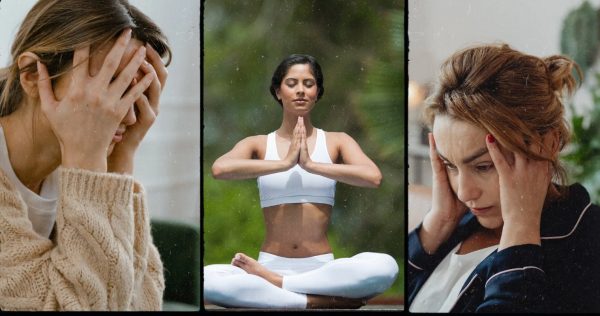
It sneaks in quietly. Your shoulders tighten. Your thoughts start racing. You check your phone, and then again… but nothing actually gets done. At the end of the day, your chest feels heavy, your mind doesn’t want to switch off, and even when you sit down to relax, your body doesn’t get the message.
That’s stress. And meditation can help, but only if you use the right kind.
If you’re feeling stressed right now, try this:
– Breathe in slowly through your nose for 4 minutes
– Exhale through your mouth for 6 minutes
– Lower your shoulders as you exhale
– Repeat 5 times
You will feel your body softening almost immediately.
Now let’s go deeper.
Best meditations for stress relief
Most people try to ‘fight’ stress. They try to push it away, distract themselves, or push through it. That usually makes it worse. The techniques below do not combat stress; they help your body and mind release these naturally.
1. Quick Relief: Guided Meditation (with Script)
When stress feels overwhelming, this guided meditation will help you relax in minutes.
Note: If you’ve never meditated before, read my guide on how to meditate at home.
When stress increases, your body holds it: tight jaw, tense shoulders, shallow breathing.
So first we’ll release that.
Sit down and feel your weight supported beneath you.
Close your eyes.
Scan your body slowly – notice where the tension lives. Your neck may feel stiff. Maybe your chest feels tight.
Now breathe into that space.
You don’t force him to relax, but just give him attention.
As you exhale, imagine the tension softening, like ice slowly melting.
Then imagine a place where you feel safe.
Not just seeing, but hearing, feeling, being there.
Stay there for a few minutes.
Let your body remember what calmness feels like.
If you have trouble relaxing on your own, I can guide you through it step by step. Book a private session.
2. Mantra Meditation for Stress Relief
Mantras are a powerful way to shift your focus from stress to calmness. The rhythmic repetition of a phrase can help calm the mind.
Try this:
-
Find a quiet place and sit comfortably with good posture.
-
Close your eyes and take 27 slow, deep breaths, feeling each inhale and exhale.
-
Repeat in your mind: “I feel tense, but this will pass. I am safe. I am calm.”
-
With each inhale, silently say “Relaxing.” Say “calming” with each exhale.
-
Continue with 108 deep breaths to soften your body and mind.
The repetition of these words helps reshape your response to stress, putting you in a more peaceful state.
If stress keeps coming back – the same thoughts, the same tension – it is usually not about effort. It’s about using the wrong technique for your mind.
In private sessions I help you discover what really works for you.
Book a session and we will solve it together.
3. Mindfulness: Observe stress without reacting
Mindfulness does not immediately remove stress. It changes your relationship with it. Instead of being trapped in stress… start observing it. And the moment you can observe it, you are no longer controlled by it.
That’s where the shift happens.
Mindfulness teaches you to recognize stress without becoming overwhelmed by it. Instead of resisting stress, learn to sit with it and observe it neutrally.
How to practice:
-
Sit comfortably and focus on your breathing.
-
When stress arises, don’t fight it. Instead, observe it: how does it feel? Where is it in your body?
-
Acknowledge it without judgment. Just notice it and let it be.
-
The more you practice, the less control stress you experience.
Mindfulness is a long-term solution to stress: it trains your brain to respond clearly to challenges instead of panicking.
4. Deep Stress Relief: Buddhist and Vipassana Meditation
Buddhist meditation techniques, especially Vipassana, help you understand your thoughts and emotions, making stress easier to manage.
Try this:
-
Sit in a quiet room and focus on your breathing.
-
When a thought or emotion arises, name it: “thinking,” “worry,” “fear.”
-
Instead of reacting, just note it and return to your breathing.
This method trains the mind to detach from stressful thoughts, giving you a greater sense of control over your emotions.
This technique is part of my business meditation sessions. Please contact us if you would like to know more.
5. Moving meditations: yoga, tai chi and walking meditation
If sitting still isn’t for you, mindful exercise can be just as effective at reducing stress.
Best Moving Meditations for Stress Relief:
-
Yoga: Synchronizes breathing and movement to release stress.
-
Tai Chi & Qigong: Maintain balance and stillness while moving.
-
Walking meditation: Focus on every step, every breath and let go of the mental chatter.
Adding movement to your meditation practice can make it easier for you to stay present and process stress.
The science of meditation and stress relief
Meditation is not just about relaxation; it actively changes the way your brain and body handle stress.
-
Activates the parasympathetic nervous system: This is your body’s natural relaxation response, which lowers heart rate and blood pressure.
-
Reduces activity in the amygdala: This part of the brain is responsible for anxiety and stress responses. This also helps with anxiety.
-
Strengthens the connections between the prefrontal cortex and the amygdala: This improves emotional regulation, helping you stay calm in stressful situations.
-
Reduces inflammation: Chronic stress leads to inflammation in the body, which can cause long-term health problems. Meditation helps counteract this effect.
Scientific research has consistently shown that meditation is one of the most effective tools for dealing with stress.
Ready to stop the stress and find peace?
I have seen people move from constant tension to a quiet, steady calm – not because life became easier, but because they learned to respond differently.
That moment when your mind slows down… your shoulders slump… and you realize you’re okay? That’s what meditation gives you.
If you need help getting there, I will guide you.
Book a private meditation session today and let’s make meditation work for you.
Paul Harrison is a meditation teacher with 25 years of experience and a deep passion for helping others. Known for his empathy and authentic approach, he is committed to guiding individuals and teams towards mindfulness, clarity and well-being.